
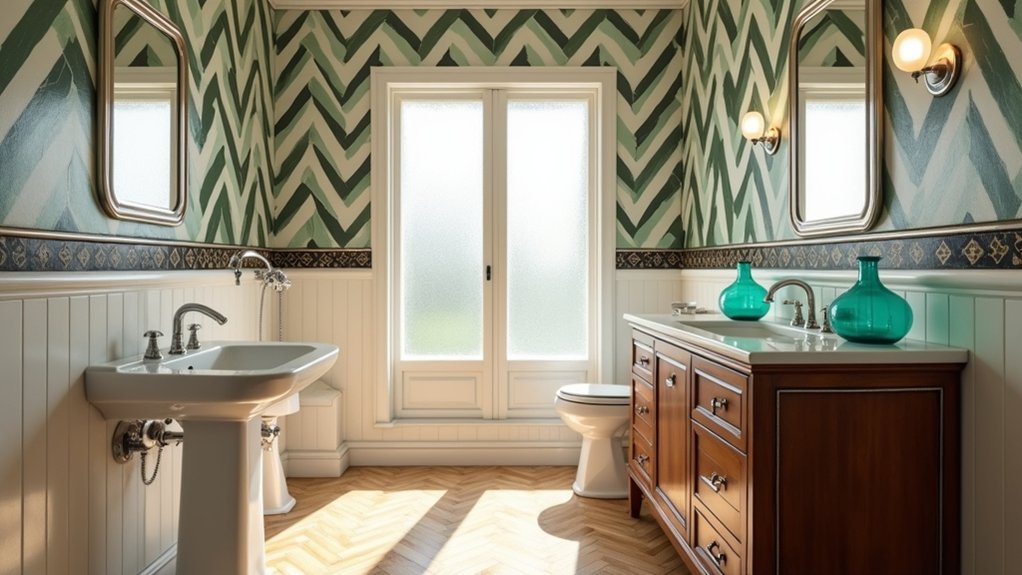

Art Deco bathroom reforms fuse timeless geometry with luxe, moisture‑resistant materials and precise space planning. You’ll see symmetry, bold contrasts, and geometric mosaics paired with chrome, glass, and lacquer finishes that reflect ambient light without glare. Expect Deco-ready plumbing routes, concealed storage, and durable grout, along with dimmable lighting to shift from theatrical to practical atmospheres. Maintenance stays straightforward with gentle cleansers and color‑safe sealants. If you want deeper insight, you’ll discover how to implement these principles step by step.
Art Deco Bathing: Setting the Tone for Modern Renovations
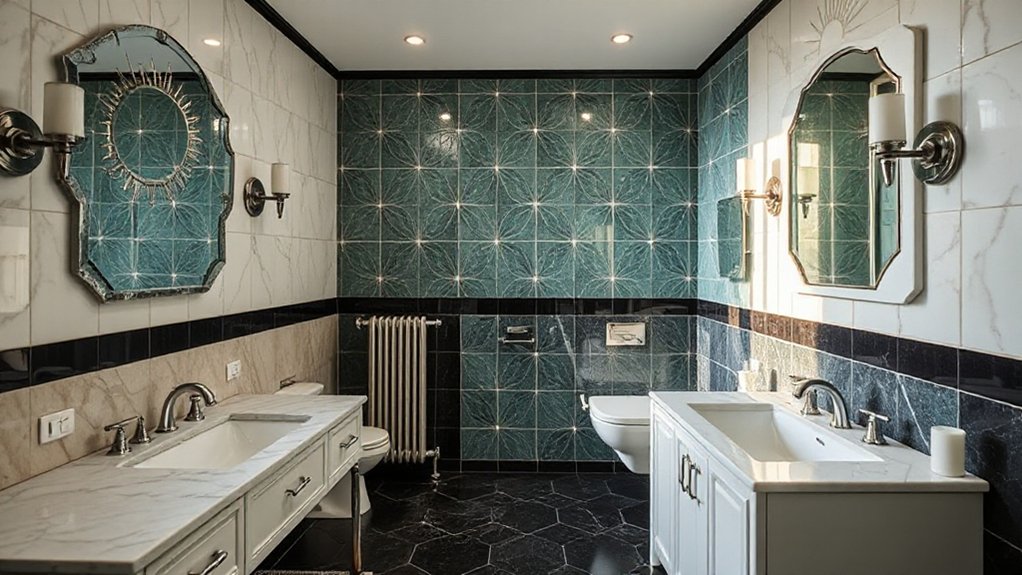
Art Deco Bathing defines a precise, high-contrast aesthetic that sets the tone for modern renovations. You assess your space by prioritizing symmetry, streamline forms, and purposeful contrasts, ensuring each fixture reads as a technical statement rather than ornamental excess.
In practice, you align proportions with geometric clarity, selecting materials that emphasize luster and durability. Focus on Art Deco symbolism to convey meaning through motifs—sunbursts, zigzags, stepped forms—while maintaining functional efficiency.
Deco architectural elements guide your layout decisions; incorporate verticality with clean lines, beveled mirrors, and flush-mounted hardware to minimize visual clutter. You document dimensions, tolerances, and installation sequencing, ensuring that plumbing, ventilation, and lighting integrate seamlessly.
The result is a cohesive, legible bathing environment where design intent remains unmistakable and maintenance remains straightforward.
Deco Color Palettes That Read Timeless
Color psychology guides you toward colors that surface psychology-friendly associations—deep greens for stability, sepia for warmth, ivory for openness—without overpowering architectural details. You use restrained saturation to preserve legibility across textures, ensuring walls, tile, and cabinetry read as a cohesive unit rather than competing elements.
In practice, you pair high-contrast neutrals with a single saturated accent to anchor rooms and emphasize symmetry. Your palette supports artistic expression while remaining durable, easy to maintain, and timeless, so the bathroom remains coherent through evolving Deco influences.
Emulating Iconic Deco Fixtures in Today’s Baths
You can start by identifying iconic fixture inspirations and evaluating how they define the room’s rhythm and silhouette.
We translate these Deco cues into modern adaptations, balancing period detail with contemporary performance and water efficiency. This approach keeps the design precise, intentional, and consistent with a polished, technically informed bathroom reform.
Iconic Fixture Inspirations
Emphasize finish choices, pairing high-polish chrome or brass with matte black accents to mirror Deco contrasts. Integrate Art Deco sculpture cues through scale and proportion, ensuring fixtures read as cohesive elements rather than isolated ornaments.
Decorative motifs appear in bracket supports, stepped backplates, and tiered soap dishes, providing a refined cadence. Maintain technical accuracy by prioritizing water efficiency, correct installation tolerances, and durable materials suitable for high-traffic bathrooms.
Modern Deco Adaptations
Material choices favor high-contrast blends—chromed metals, black glass, and creamy porcelain—so lines remain crisp and legible. You prioritize efficient flows, pairing compact floor-mounted toilets with wall-hung configurations to sustain legibility of geometry at all heights.
Fixtures should carry refined detailing—step-facets, key-lock seams, and beveled edges—without visual clutter, delivering Vintage charm without sacrificing durability. You incorporate artistic details through tiling patterns and lighting that emphasize symmetry.
In execution, measured tolerances, quality finishes, and proper installation preserve the Deco language while meeting modern performance standards.
Deco-Ready Materials: Luxury Without Compromise
You’ll explore Deco-Ready Materials that balance durability with a lasting, high-shine finish. This section highlights how luxury materials can meet everyday practicality without compromising longevity or maintenance.
You’ll see how the convergence of durability, timeless shine, and accessible luxury sets the standard for truly refined, functional baths.
Durable Materials, Timeless Shine
Durable materials define Deco-Ready bathrooms by delivering lasting performance without sacrificing style. You’ll notice how high-grade composites, ceramics, and metals resist moisture, heat, and daily wear while preserving their edge.
In practice, selection hinges on load tolerance, finish longevity, and maintenance cycles, ensuring a consistent shine without frequent replacement. You prioritize stability over fleeting trends, choosing surfaces with low porosity and proven resistance to staining and scratching.
This approach supports sustainable practices by minimizing waste and extending service life. Eco-friendly materials, when properly specified, align with indoor air quality goals and reduce lifecycle environmental impact.
Expect predictable coloration, uniform gloss, and reduced maintenance demands, enabling you to sustain a refined Deco-Ready aesthetic across decades.
Luxury Meets Practicality Now
Luxury and practicality converge in Deco-Ready materials, delivering premium aesthetics without sacrificing performance. You’ll select surfaces and fixtures engineered for durability, ease of maintenance, and timeless appeal, aligning form with function.
Deco-Ready choices balance high-gloss finishes, corrosion resistance, and precise tolerances to guarantee longevity in wet environments. You’ll appreciate how historical influences inform scale, geometry, and detailing, while modern composites provide consistent color and minimal porosity.
Cultural symbolism is translated into material language—sunbursts, chevrons, and stepped forms—without compromising hygiene or maintenance cycles. Implementing these materials supports rapid installation and predictable care routines, reducing lifetime costs.
The result is a bathroom that communicates luxury through clean lines and restrained ornament, delivering performance that meets contemporary codes while honoring Art Deco heritage.
Geometry in Deco: Lines, Angles, and Proportions
Geometry defines Art Deco bathroom design through precise lines, angles, and proportions that organize space and reinforce a modern, streamlined aesthetic. You observe how rhythm and scale drive visual order, while you guarantee comfortable flow and functional clarity. This geometry yields disciplined, refined surfaces, where artistic patterns meet structural balance.
- Aligns fixtures to grid coordinates, creating confident symmetry.
- Defines corner radii and edge progressions for crisp restraint.
- Emphasizes proportional relationships between mirrors, cabinetry, and lighting.
You apply these principles to achieve a coherent composition, balancing ornament with restraint. The approach supports durable materials and precise fabrication, delivering a polished, authoritative result. Your choices reflect artistic patterns without overwhelm, and you safeguard structural balance across planes, affirming a timeless Deco integrity.
Deco Tile Patterns: Bold Blocks, Geometric Mosaics
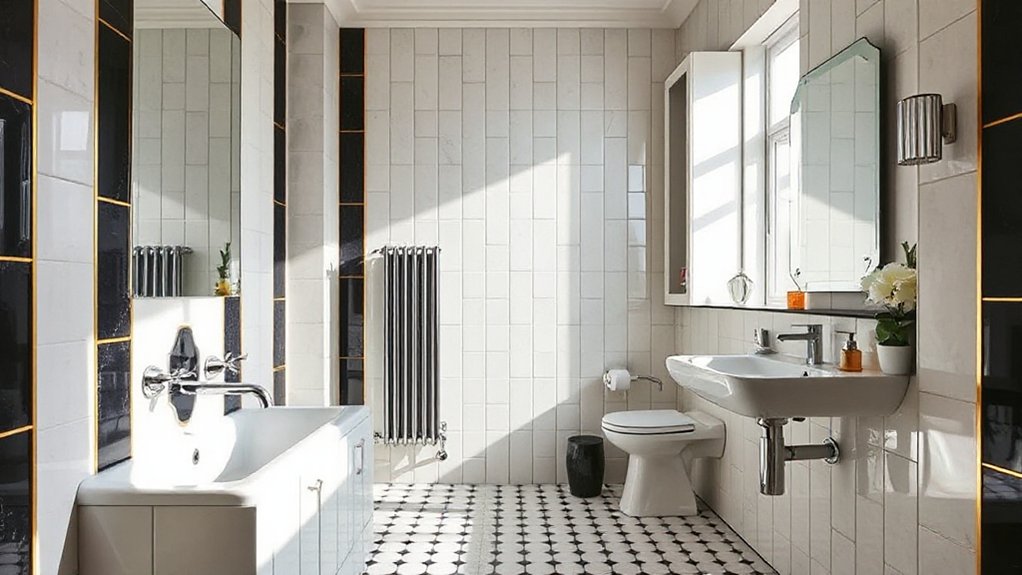
You’ll explore how bold block arrangements establish a strong rhythm across surfaces, creating focal points without sacrificing cohesion.
Geometric mosaic play introduces intricate interlocks that read as architectural texture, guiding the eye through the space with precise geometry.
Pairing colors in tile selections matters for balance, contrast, and the characteristic Deco sharpness.
Bold Block Arrangements
- Choose large, solid blocks framed by narrow grout lines to maximize impact.
- Align blocks to emphasize symmetry, creating a disciplined, architectural feel.
- Pair bold blocks with subdued surroundings to maintain balance and readability.
This method remains technically coherent, aesthetically decisive, and performance-driven, ensuring long-term durability.
It suits monochrome palettes or two-tone schemes, where clarity and refinement trump whimsy.
Geometric Mosaic Play
In practice, you select tessellations that balance density with breathing room, ensuring each tile contributes to a cohesive narrative rather than competing signals. The approach favors high-contrast edge work, where sharp lines delineate polygons and emphasize geometric cadence.
You evaluate grout as a design parameter, matching or deliberately contrasting tile hues to intensify visual impact. Mosaic patterns emerge as structured yet adaptable, guiding eye movement along walls and around fixtures.
Color contrasts anchor emphasis, supporting clarity within complex, modular assemblies.
Colorful Tile Pairings
- Assess contrast: pair high-saturation tiles with neutral surrounds to maintain clarity and depth.
- Align patterns: synchronize block and mosaic modules to emphasize rhythm, avoiding visual clutter.
- Maintain finish integrity: choose tile sealing that protects color integrity and eases maintenance, then apply color-safe grout for durable articulation.
Colorful grout accents emphasize shifts, while precise sealing preserves vibrancy. You’ll verify grout consistency, sealant compatibility, and cleanup post-install to guarantee lasting effect and uniform tone throughout the installation.
Glamorous Lighting for Deco Bathrooms
Glamorous lighting in Deco bathrooms combines form and function to highlight the era’s geometric lines and luxe materials. You select fixtures that balance symmetry with bold detail, ensuring proportions echo architectural motif.
Prioritize chrome, glass, and lacquered finishes to reflect ambient glow while preserving clarity of lines. Layer light with a mix of wall sconces, ceiling pendants, and vanity lamps, avoiding clutter to maintain a streamlined silhouette.
Position sources to minimize glare and maximize depth, using indirect uplighting to sculpt corners and reflectors to emphasize metallic surfaces. Consider dimmable controls to *shift* from theatrical to practical tasks, preserving Vintage charm without sacrificing precision.
Artistic expression emerges through fixture pairings and scale, delivering a cohesive, timeless atmosphere that reinforces Deco identity.
Space-Smart Layouts With Deco Flair
You optimize a Deco bathroom by pairing Smart Storage Solutions with precise Gleaming Fixture Placement, ensuring every inch serves function without compromising style.
By guiding Geometric Space Flow, you create clear sightlines and efficient movement, preserving a sense of openness.
This approach establishes a disciplined framework that blends practicality with Art Deco flair.
Smart Storage Solutions
Smart storage in Art Deco bathrooms blends space efficiency with bold geometry, delivering storage that feels integral rather than added. You’ll optimize layouts by selecting recessed or built-in units that echo the era’s crisp lines, minimizing visual clutter while maximizing capacity. Focus on three core strategies:
- Integrate vanity cabinetry with concealed drawers and rotating interiors for flexible, compact storage.
- Employ wall-mounted shelves and magnetized or push-to-open panels to keep surfaces clean and accessible.
- Use slim medicine cabinets featuring mirrored fronts and integrated lighting, balancing form with function.
To reinforce the aesthetic, choose elements that nod to Vintage patterns and Artistic murals, ensuring hardware, finishes, and detailing remain cohesive.
This approach delivers space-smart layouts with deco flair that feel purposeful, not ornamental.
Gleaming Fixture Placement
Ideal fixture placement matters in Art Deco bathrooms, balancing eye-catching geometry with efficient flow. You optimize space by aligning gleaming fixtures to dominant sightlines and traffic corridors, reducing cross-traffic friction while preserving bold silhouettes.
Prioritize wall-mounted radiance and compact basins to free floor area, then anchor with a streamlined vanity that echoes stepped forms. Position the toilet and bidet with a minimum setback from primary entrances to preserve symmetry without sacrificing accessibility.
Consider glare reduction through controlled lighting that highlights chrome, black lacquer, and glass accents without creating hotspots. Plan fixture placement to emphasize vertical rhythm: plinths, vertical panels, and stepped niches guide the eye upward, reinforcing deco contrasts.
Gleaming fixtures integrate function and glamour, delivering disciplined ornament without crowding the room.
Geometric Space Flow
- Align fixtures to create clear pathways and balanced focal points.
- Layer textures and reflected light to diffuse brightness evenly.
- Reserve intentional gaps to emphasize form, reduce clutter, and improve accessibility.
This framework delivers a disciplined, Deco-flavored workflow that remains practical and scalable.
Find Period-Accurate Hardware: Where to Look
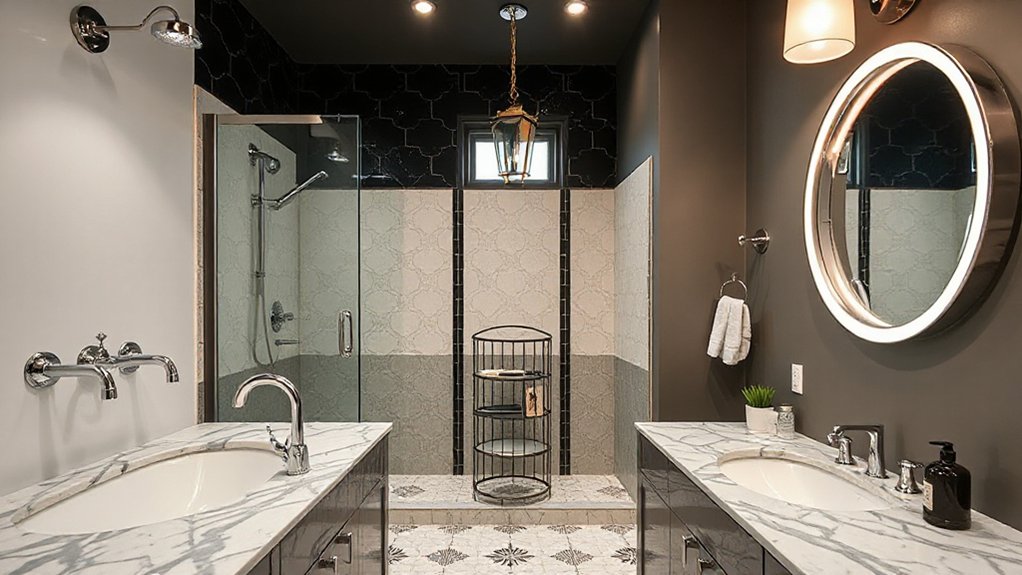
To find period-accurate hardware, start with reputable sources that specialize in Art Deco hardware and period fixtures, not generic modern reproductions. You’ll want cataloged inventories, period-accurate dimensions, and authentic finishes that align with 1920s–1930s design language.
Prioritize vendors offering certified vintage lighting, reproductions with correct stamping, or clearly documented restoration parts. Cross-check hallmarks, screw sizes, mounting depths, and knurling patterns against original manufacturer literature.
Assess hardware restoration with attention to patina compatibility, ensuring replacements match aging characteristics without disguising provenance. Avoid mixing styles; select streamlined geometric forms, stepped profiles, and chrome or nickel finishes typical of the era.
Maintain provenance records for resale value and restoration fidelity, and establish a conservative budget for authentic components.
Finishes That Withstand Wet Environments in Deco Baths
In Deco bathrooms, choose finishes that resist moisture and corrosive cleaners without compromising period logic. You’ll select materials that survive damp atmospheres while preserving era-appropriate aesthetics.
Prioritize finishes that deter staining and salt spray, and pair them with reliable seals and detailing.
- Marble countertops: opt for sealed variants with low porosity and a durable topcoat to prevent etching and water ingress.
- Brass fixtures: select oxidized or lacquered finishes that resist tarnish and moisture without sacrificing the Deco silhouette.
- Tile and plaster joints: use moisture-resistant grouts and sealed plaster, ensuring long-term stability under frequent exposure to humidity.
These choices deliver enduring elegance with practical performance, aligned to Deco principles, featuring Marble countertops and Brass fixtures.
Smart Tech That Complements Deco Style
Smart tech can elevate a Deco bathroom without breaking the period aesthetic, pairing modern convenience with timeless geometry. You implement integrated sound systems that blend into cabinetry profiles and chrome trims, preserving clean lines while delivering high-fidelity audio.
Voice control enables hands-free operation of lighting, climate, and ventilation, yet you keep interfaces discreet, using tactile switches and backlit indicators that mirror Art Deco symmetry. Prioritize modular components with minimalist profiles and facades that echo geometric motifs—steps, chevrons, and stepped baselines—so tech remains a supporting element.
Selecting wireless platforms with robust privacy helps maintain the era’s measured restraint. You map zones for ambient, task, and accent lighting, ensuring color temperatures respect warm or cool palettes. Across surfaces, finish-match connectors sustain a cohesive Deco narrative.
Vintage-Influenced Storage in Small Bathrooms
Vintage-inspired storage in small bathrooms builds on the modular, discreet tech foundations you’ve already set, pairing efficient organization with Deco-friendly detailing. You’ll optimize footprint without sacrificing style, leveraging crafted fronts, geometric pulls, and mirrored interiors for rapid access.
Consider these capsule strategies:
- Compact cabinetry with vertical dividers that maximize corner and under-sink space.
- Floating shelves with integrated lighting to reduce clutter while emphasizing vintage charm.
- Multiuse trunks or ottomans that conceal daily essentials yet read as Deco accents.
These approaches deliver refined storage solutions that sustain clean lines and tactile elegance. You’ll maintain a crisp, cohesive aesthetic while enhancing usability, ensuring every item has a designated, accessible home.
Vintage charm meets practical efficiency through deliberate material choices and precise joinery.
Plumbing and Ventilation for Deco Renovations
You’ll align your Deco renovation with current ventilation standards to guarantee indoor air quality and moisture control.
We’ll map plumbing pipe routing for symmetry and access, while prioritizing hidden runs that preserve the era’s aesthetic.
Expect concise strategies on moisture management, combined with reliable ventilation performance to support long-term bathroom integrity.
Ventilation Standards For Deco
- Air filtration: select high-efficiency, low-noise filters compatible with vintage systems to reduce particulates without overburdening fans.
- Moisture management: install balanced exhaust and supply schemes with humidity controls to prevent condensation on decorative surfaces.
- Zoning and monitoring: employ smart sensors to sustain consistent air changes per hour, track filtration status, and alert you to leaks or blockages.
This approach keeps interiors stable, preserves finishes, and aligns with current standards for Deco renovations.
Plumbing Pipe Routing
Efficient plumbing pipe routing in Deco renovations prioritizes clean, concealed runs that minimize visual disruption while ensuring reliable service. You plan routes behind walls, within soffits, or under floor voids to preserve the distinctive geometry of Deco spaces.
Start with a centralized spine and branch only where necessary, reducing penetrations through decorative panels. Use compact, split-leaf or quadrant layouts to align with cabinet cores, vanity backs, and tile joints, maintaining symmetrical rhythms.
Materials should be corrosion-resistant and sized for anticipated water demand, with slope and venting calibrated to prevent trap siphonage.
Prioritize pipe concealment through built-in chase walls and recessed chases; disguise elbows with square offsets that echo geometric motifs.
Document routing diagrams for future maintenance, ensuring accessibility without compromising the aesthetic integrity of the bathroom.
Moisture Control Strategies
Moisture control in Deco renovations hinges on integrated plumbing and ventilation strategies that prevent condensation, mold growth, and material degradation. You’ll implement moisture barriers and optimized ventilation systems to maintain stable humidity levels and protect plaster, tile, and metal finishes.
- Assess enclosure airtightness and install continuous moisture barriers at wet zones to minimize vapor intrusion.
- Select ventilation systems with heat recovery and humidity sensing to balance air exchange with energy efficiency.
- Detail duct routing and exhaust termination to avoid condensate pockets and backdraft risks, ensuring reliable moisture removal.
This approach emphasizes precise detailing, durable materials, and ongoing monitoring, so your Deco bathroom remains resistant to moisture-driven deterioration while preserving authentic design cues.
Budgeting Your Art Deco Bath Renovation
Carefully plan your Art Deco bath renovation by establishing a realistic budget that accounts for both essentials and optional upgrades. You’ll categorize costs into structural, plumbing, finishes, fixtures, and lighting, then assign contingency funds for unforeseen issues.
Prioritize enduring, period-appropriate features to maximize return on investment while limiting overextensions. When selecting materials, weigh upfront costs against long-term durability and maintenance needs, favoring Eco friendly materials where feasible to reduce lifecycle expenses.
Compare supplier quotes for core components—tile, vanity, and brass hardware—with attention to precision tolerances and finish compatibility.
Plan a staged rollout to avoid peak expenditure periods and leverage seasonal promotions.
For ambiance, budget for vintage lighting that harmonizes with the Deco theme without inflating installer complexity.
Maintain meticulous records to monitor variance and adjust scope proactively.
DIY vs. Pro: When to Hire for a Deco Makeover
We’ve mapped a practical budget in the previous step, but a Deco makeover hinges on who handles the work. You’ll decide between DIY and pro based on scope, risk, and finish goals, prioritizing vintage elegance and color harmony.
- Assess complexity: electrical, plumbing, and cabinetry tasks demand skilled execution to protect safety and style.
- Evaluate time and disruption: a pro reduces downtime and guarantees consistent line work, essential for Deco symmetry.
- Define finish standards: pros deliver durable, high‑gloss surfaces and precise metalwork that sustain authentic aesthetics.
DIY can suit minor updates, mosaics, or noncritical paint, while a pro handles hardware integration, waterproofing, and certifications. Your choice should align with quality expectations, budget realism, and long‑term value.
Color harmony depends on disciplined execution and project planning. Vintage elegance remains the central target.
Case Studies: Restored Gems and Modern Twists
Case studies illuminate how restored gems and modern twists can coexist in a Deco bathroom without compromising period character. You analyze projects that preserve original geometry and material grammar while integrating contemporary amenities.
You observe how vintage glamour is retained through reconditioned porcelain, beveled mirrors, and lacquered chrome accents, contrasted with discreet digital controls and water-saving fittings.
You assess the balance between restoration and reinterpretation, noting that successful outcomes rely on precise tolerances, repeatable patterns, and consistent finish levels.
You evaluate restoration techniques, materials sourcing, and schedule management, ensuring minimal invasive work.
You recognize artful craftsmanship in detailing—moldings, inset tile, and metalwork—maintaining cohesive visual language.
The case studies demonstrate disciplined curation, purposeful contrast, and durable, low-maintenance performance that honors architectural intent.
Family and Pet-Friendly Deco: Practical Comforts
Family and pet-friendly features in a Deco bathroom prioritize durable materials and practical layouts without sacrificing the period aura. You design for resilience, easy maintenance, and safety, while preserving Vintage charm and the visual cadence of the era.
Your choices emphasize slip-resistant floors, heat-resistant surfaces, and integrated storage that fits the streamlined geometry of Art Deco.
- Durable countertops and splash areas
- Rounded edges and non-slip details for high-traffic zones
- Pets’ access points and waste solutions that blend with the mosaics
You pair these practical elements with Artistic mosaics to maintain authentic rhythm, using bold contrasts and metallic accents to reinforce the Deco language.
The result is a space that remains elegant, functional, and ready for daily life without compromising stylistic integrity.
Maintenance Myths and Truths for Deco Finishes
Maintenance myths about Deco finishes can lead you astray if you rely on outdated advice; knowing what’s true helps protect the period look without compromising durability. In practice, Deco surfaces respond to deliberate care rather than aggressive treatments.
Use appropriate cleaners formulated for porcelain, enamel, or lacquer, and avoid abrasive pads that dull sheen. Regular dusting with a soft cloth keeps patina intact and reduces soil buildup.
When evaluating bathroom lighting, choose fixtures that complement gloss without creating hot spots or fade risk; this informs finishing choices and longevity.
For tile installation, verify proper sealing at edges and joints to deter moisture intrusion, which can deteriorate relief details.
If repairs are needed, favor period-accurate finishes and documented restoration methods to maintain authenticity.
Frequently Asked Questions
How Long Does a Full Art Deco Bathroom Renovation Typically Take?
A full Art Deco bathroom renovation typically takes about 4 to 6 weeks. You’ll source vintage fixtures, install plumbing, and apply finishes while embracing geometric patterns, ensuring every detail aligns with the era’s precise, polished, authoritative standards.
What Hidden Costs Commonly Pop up in Deco Projects?
Hidden costs commonly pop up in deco projects: you’ll face overruns from material fluctuations, permit delays, and change orders. Do thorough cost estimation before starting, and guarantee contractor selection emphasizes transparent pricing and scope control.
Can Deco Style Work in Small Bathrooms Without Crowding Space?
Yes—you can. In small bathrooms, you’ll optimize space with vintage fixtures and geometric patterns; use wall-mounted units, reflective surfaces, and compact fittings to preserve flow while preserving authentic Deco character.
Which Deco Elements Increase Bathroom Resale Value Most?
Vintage fixtures and geometric patterns boost resale value most; you should prioritize durable finishes, proper lighting, and balanced proportions, ensuring timeless appeal. You’ll maximize market impact by integrating cohesive colors and carefully chosen detailing that lengthens perceived room size.
How Do You Balance Authenticity With Modern Code Upgrades?
You balance authenticity with code upgrades by prioritizing historical accuracy in detailing finishes and layouts, while ensuring electrical and plumbing updates meet modern standards; emphasize material authenticity, substrate compatibility, and documentation to deliver compliant, historically faithful renovations.
Conclusion
You’ll finish with a bathroom that feels timeless, yet unmistakably modern. Like a well-tuned orchestra, Deco elements align—shape, color, fixture—each note precise, each cadence deliberate. You’ll see how geometry guides flow, how durable finishes stand scrutiny, and how care rituals keep luster long after the initial reveal. Remember the whispers of the past as you design for today; the era’s elegance remains a practical guide, not a relic, sustaining beauty, function, and a lasting sense of place.