
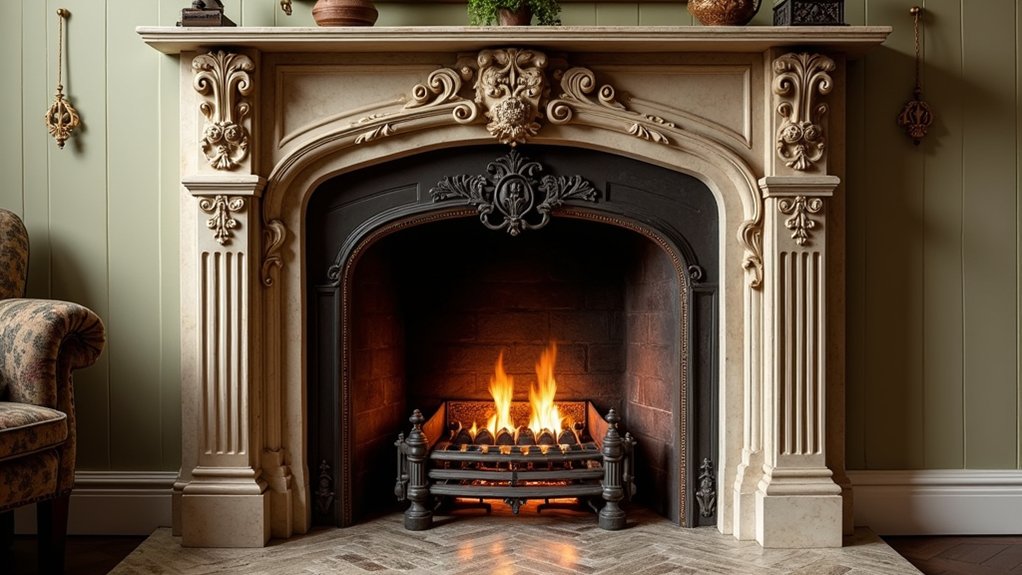

Victorian fireplaces fuse bold ornament with practical design to create a timeless focal point in any room. You’ll notice massed ornament, carved surrounds, and a masonry-firebox that supports both stability and beauty. Surfaces—stone for gravitas, tile for color, and cast iron for detail—work together to balance heat, durability, and style. Heat transfers through conduction, convection, and radiation, while open fires evolved into efficient grates and gas or electric inserts. If you want more, you’ll uncover how to apply these principles in your space.
What Makes Victorian Fireplaces Stand Out
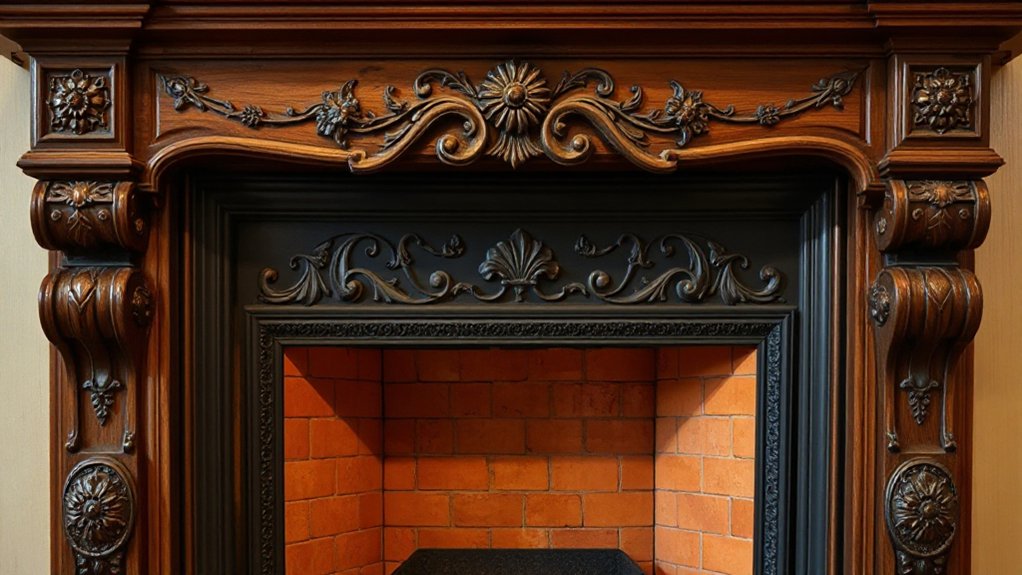
Victorian fireplaces stand out for their bold craftsmanship and ornate detailing, which signal a era that valued decoration as much as function. You notice how massed ornament, scrolled mantels, and tilework convey status while serving warmth and atmosphere.
Victorian lighting informs the design—gas fixtures or early electric fits harmonize with carved surrounds, creating cohesion between flame and frame. You’ll also perceive purposeful proportions: tall, granite or cast-iron mantels frame fires, while decorative motifs—rosettes, acanthus, latticework—guide the eye without overwhelming the room.
The era’s attention to ventilation supports comfort, shaping flue paths and hearth depth. Victorian gardening influences appear in garden-inspired motifs and verdant enamel tones that pair with natural light, reinforcing the hearth as a transitional focal point rather than a solitary appliance.
The Core Components of a Victorian Hearth
You’ll start with the core structural elements—the surround, lintel, and hearth, which define the fireplace’s form and safety.
Then you’ll examine the heat transfer mechanisms—the grate, flue, and damper—that determine how efficiently warmth moves into the room.
Together, these components establish both function and character, guiding how Victorian hearths perform and endure.
Core Structural Elements
The core structural elements of a Victorian hearth comprise the mantel, apron, surround, and firebox, each engineered to support and frame the flame while directing heat into the room. You examine how the mantel provides a horizontal focal line, while the apron shields and defines the lower edge.
The surround establishes the boundary between interior and fireplace, and the firebox contains the grate and fuel, ensuring safe, efficient combustion. These elements are engineered for stability, load distribution, and moisture resistance, reflecting deliberate Victorian craftsmanship.
You’ll see how material choice and moldings reinforce structure without compromising function. Decorative motifs often inform the design language, yet structural integrity remains paramount.
In practice, these components integrate to deliver both support and a coherent, aesthetically controlled focal point.
Heat Transfer Mechanisms
Heat transfer in a Victorian hearth occurs through three primary pathways: conduction through masonry and metal, convection via circulating air, and radiation from the open flame and heated surfaces.
You assess each mechanism to gauge overall efficiency and comfort.
Conduction transmits heat through brickwork and cast iron, shaping thermal mass and response time.
Convection relies on air movement—stoked drafts and flue arrangement drive warm air outward while cooler air returns, sustaining a steady thermal loop.
Radiation delivers radiant heat from the fire and hot surfaces, creating immediate warmth at contact.
You recognize how Victorian aesthetics influence surface treatments and detailing, while Fireplace craftsmanship determines the quality of joints, fit, and airflow channels.
Together, these mechanisms define performance, influence room ambiance, and reflect enduring design discipline.
The Evolution of Surfaces: Stone, Tile, and Cast Iron
From stone to tile to cast iron, surfaces have driven fireplace design as surely as flames drive heat. You examine stone for permanence and heft, appreciating its sense of gravitas in Victorian rooms.
Tile introduces color, pattern, and texture, enabling decorative motifs that reflect era flourish without sacrificing function.
You note cast iron’s versatility: crisp profiles, intricate detailing, and the capacity to fuse strength with delicate ornament.
Victorian craftsmanship emerges in how joints, finishes, and edges read as deliberate choices rather than mere material; each surface communicates intent.
Surfaces dictate heat distribution, maintenance, and prominence, guiding fireplace placement and room cohesion.
You see harmonized contrast: rugged stone, glazed tile, and glossy metal, each contributing to a unified, enduring design language.
From Open Fire to Grate: How Heat Was Managed
As rooms grew warmer and layouts shifted, builders turned from open flames to enclosed grates to tame heat without sacrificing ambiance. You examine how heat migrated from uncontained flames to metal enclosures, optimizing airflow, shielding surrounding surfaces, and directing warmth outward.
The evolution supported Victorian lighting goals by stabilizing room temperature for gas and oil lamps, reducing smoke impact, and improving safety. Hearth cleaning became routine maintenance, preserving efficiency and reducing odors as soot accumulated in grates and flueways.
You’ll notice design constraints: metal grates, doors, and dampers balancing heat retention with ventilation, all calibrated to public rooms and private parlors alike. The progression marks a disciplined approach to comfort, cleanliness, and consistent illumination.
- Emittance control through dampers and closures
- Regular Hearth cleaning to sustain efficiency
- Integration with Victorian lighting for steady ambiance
Mantels and Fretwork: Ornament Meets Utility
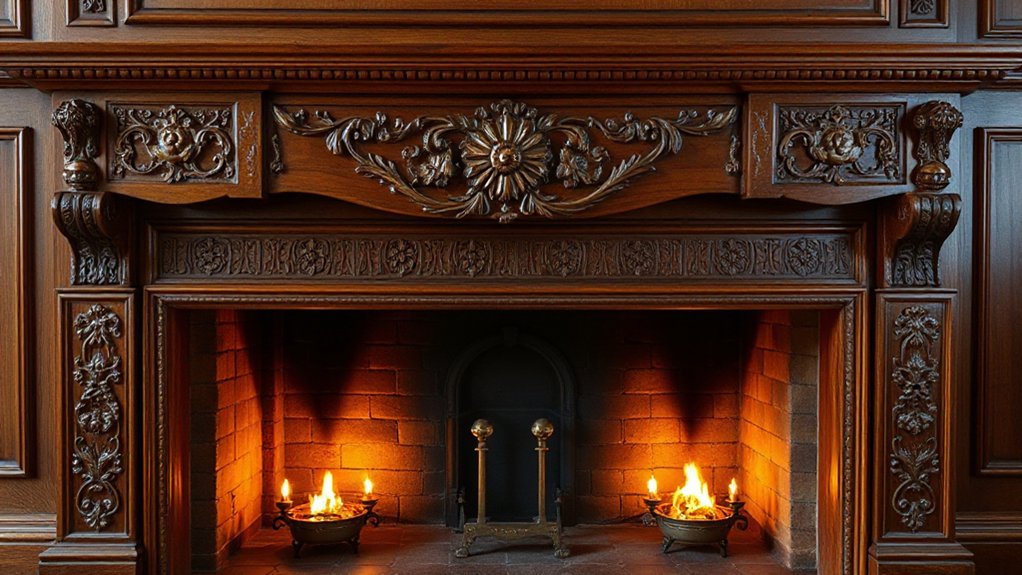
Mantels and fretwork fuse ornament with utility, shaping the room’s silhouette while guiding the eye toward the hearth. You’ll notice how mantel design frames the fire, turning it into the focal point without dominating the space.
In Victorian craftsmanship, joinery and proportion enforce balance: cornices, friezes, and supports echo decorative motifs while remaining structurally sound. Fretwork adds texture through geometric and botanical screens, offering ventilation paths and visual rhythm without obstructing heat flow.
Each element conveys status and taste, yet remains purposeful: shelves provide display, brackets support stone or wood, and paneling reinforces stability. The interplay of carved motifs and clean lines demonstrates how ornament can enhance function.
Your surroundings benefit from restrained grandeur that respects both aesthetics and practicality.
The Role of Tilework in Victorian Surrounds
Tilework in Victorian surrounds does more than decorate; it defines formal spaces, frames the hearth, and anchors color, texture, and pattern across a room. You engage with Victorian tile patterns to control focal points and acoustic ambiance, guiding sight from mantel to perimeter.
Decorative encaustic tiles introduce durable color inlay and geometric rhythm, resisting wear while signaling status and taste. The material choice balances artistry with function, ensuring that each surround reads as cohesive, deliberate design rather than incidental ornament.
- Clarifies room hierarchy through color and pattern
- Demonstrates craft with durable, intricate encaustic surfaces
- Elevates the hearth as a central, unifying feature
Luxurious Surfaces: Marble and Other Materials
You’ll explore marble texture trends and how variations in veining, polish, and color elevate a Victorian surround.
Consider how alternative surface finishes—from honed to brass-inlaid accents—alter mood, durability, and light reflection.
This discussion lays the groundwork for selecting materials that balance authenticity with modern nuance.
Marble Texture Trends
Marble textures continue to define luxury in Victorian fireplaces, offering both timeless elegance and contemporary versatility. You’ll notice how veining can guide room mood, from restrained gravity to bold drama, shaping the fireplace’s focal point with deliberate restraint.
In current trends, marble textures pair with floral motifs to soften edges and add romantic resonance.
You’ll appreciate performance benefits—durability, heat tolerance, and ease of cleaning—without sacrificing craft.
The surface finish influences perception: polished for formal spaces, honed for understated grace, and brushed for a tactile modernism that still honors tradition.
- Veining patterns: bold versus subtle, and how they interact with floral motifs
- Finishes: polished, honed, and brushed textures for Victorian settings
- Color families: classic whites and soft neutrals with warm metallic accents
Alternative Surface Finishes
As marble textures set a high standard for elegance, consider how alternative finishes expand the palette without sacrificing luxury. You’ll explore surfaces that complement, not imitate, marble’s prestige.
Porcelain and ceramic can emulate veining with durable resilience, while metallic or glass-inset accents deliver a modern counterpoint to Victorian forms.
A seasoned approach blends textures: a Victorian tile surround contrasts with a smooth marble surface, or incorporates matte plaster for depth without glare. Wood veneers and honed stones offer warmth while preserving refinement.
When selecting, assess heat resistance, cleaning ease, and aging pattern under frequent use. This strategy preserves timeless allure while introducing subtle, contemporary nuance.
Your choice should reinforce proportion, balance, and craftsmanship, ensuring the fireplace remains a focal point of refined domestic luxury.
Coal-Fired Efficiency: Practical Hearth Principles
Coal-fired efficiency hinges on controlled combustion and heat capture, so you’ll optimize a Victorian hearth by sealing air leaks, maintaining proper draft, and choosing the right grate and firebox size for your room.
- Focus on airtight controls and clean flues to sustain steady heat delivery.
- Select a grate that balances airflow with ash management, aligned to room volume.
- Tailor firebox dimensions to the fireplace’s mantle height and chimney draw for predictable burn cycles.
This approach reflects Victorian craftsmanship and emphasizes decorative symbolism through purposeful fire management, not mere display.
By prioritizing efficient fuel use and controlled flame behavior, you preserve both performance and the era’s refined aesthetic.
Maintain regular sweeps, monitor clinker buildup, and adjust air ingress to sustain warmth with minimal waste.
Early Gas and Electric Inserts: Modernizing Victorian Fireplaces
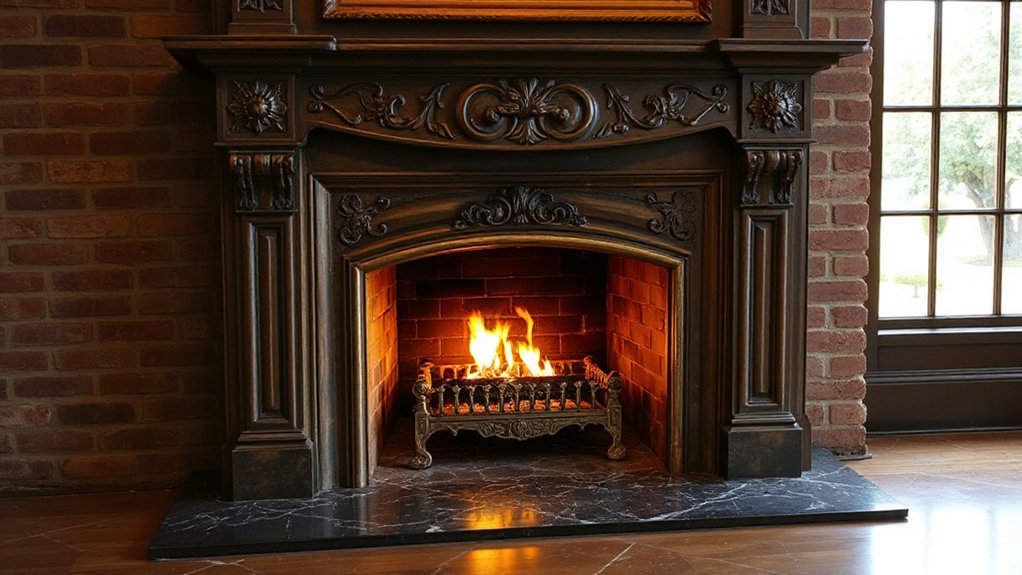
Early gas and electric inserts offered a practical path to modernizing Victorian fireplaces, preserving their ambiance while improving control and convenience. You adopt a streamlined insert, concealing mechanisms behind a traditional surround, so the room retains its period character while delivering reliable heat with adjustable flames.
Gas units provide immediate responsiveness and clean venting, reducing soot and maintenance, whereas electric inserts offer consistent performance and safety margins, including cool-to-the-touch fronts around children and pets.
Installers aligned these inserts with original mantels, or created authentic-looking surrounds to maintain the Victorian floral motif without sacrificing modern efficiency.
The result is enhanced fireplace acoustics—gentle crackle, balanced sound, and quiet operation—while you enjoy safer, more controllable ambiance that respects historic design.
Reading the Age: Restoration Clues From the Fireplace
How can you read the age of a Victorian fireplace through its clues? You survey construction details, finish quality, and tool marks that reveal workshop habits and eras. Look for joinery patterns, mortise-and-tenon methods, and brass fittings that map to specific periods of Victorian craftsmanship.
The presence of certain decorative motifs or symbolic elements can signal shifts in taste and technique, conveying historical symbolism beyond mere aesthetics. Patina, restoration steps, and repair patterns tell you about use, ownership, and preservation priorities.
Essentially, the fireplace becomes a document of manufacture, value, and intent, guiding you toward authentic dating and respectful restoration. A careful eye preserves provenance and honors the era’s lasting craftsmanship.
- Victorian craftsmanship indicators junctioned with typical period motifs
- Tool marks, joints, and metalwork revealing workshop practices
- Historical symbolism reflected in ornament and design choices
Choosing a Period-Appropriate Mantel for a Room
When selecting a mantel, you should guarantee your choice remains in scale with the room’s proportions and surrounding architectural details.
Match the mantel material and finish to the era you’re highlighting, so texture and tone read as cohesive rather than an afterthought.
Prioritize a period-appropriate silhouette that complements the fireplace opening while maintaining balanced visual weight.
Mantel Materials Match
Choosing a mantel material that matches a room’s period helps maintain authentic hierarchy and visual coherence. In this topic, you align the mantel with architectural cues, ensuring a seamless dialogue between casework, trim, and fireplace surround.
Your aim is to select a material that reads as inheritable from era, not an afterthought. Consider how wood tones or plaster finishes mirror crown molding, wainscoting, and paneling. The goal is restrained elegance that foregrounds function over flourish.
Victorian fireplace accessories and mantel decorating should appear intentional, not random. This discipline preserves period character while allowing modern usability.
Stay precise, avoid excess ornament, and prioritize material honesty.
- Match wood species and stain depth to existing millwork
- Use plaster or stone motifs that echo nearby architectural details
- Choose hardware and trim that reinforce period fidelity
Proportion and Scale
Choose proportions that echo common Victorian configurations: a substantial mantel unites with a tall, narrow opening or a broader, more horizontal balance, depending on the room’s verticality. Maintain rhythm by aligning mantel verticals with nearby columns, pilasters, or casing.
Prioritize authenticity through details that reflect Victorian craftsmanship, avoiding an anachronistic oversized statement. Decorative motifs should reinforce era accuracy, not overwhelm the room, ensuring the mantel complements its firebox and overall decor without crowding either.
Safety and Chimney Considerations for Stucco and Brick
A poorly vented or damaged chimney can turn a cozy fireplace into a serious safety risk, so start by inspecting the exterior for cracks, loose bricks, or mortar deterioration that could allow smoke and heat to escape. You’ll want to assess whether stucco shows water stains, bulging, or delamination, which compromise durability and fire safety.
Prioritize a professional Chimney inspection to confirm flue integrity, liner condition, and vent clearances. Addressing symptoms early preserves performance, reduces creosote buildup, and protects surrounding stucco or brick from moisture damage.
- Check exterior masonry for cracks, spalling, or moisture intrusion indicating compromised stucco durability
- Verify flue liner and chase are intact, properly sealed, and meet clearance requirements
- Schedule periodic inspections and cleanings to prevent creosote and soot buildup
Lighting the Room: Firelight, Gas, and Candle Interplay
You’ll weigh how firelight, gas, and candles shape the room’s mood, warmth, and shadows. Consider how Firelight Ambience Tactics interact with gas fixtures and Candle Interaction Patterns to balance brightness, safety, and period-accurate atmosphere.
This discussion starts with practical contrasts and moves toward integrated lighting strategies for Victorian spaces.
Firelight Ambience Tactics
Firelight sets the mood and defines temperature and tone, so blend fire, gas, and candlelight to control contrast and atmosphere. You guide the room’s rhythm by balancing glow, shadow, and sparkle, ensuring each source complements the other without overpowering the whole.
In this careful orchestration, Victorian floral motifs emerge in the detailing you highlight with light, while decorative plasterwork emphasizes texture and depth at flame height. Precision matters: adjust luminance to reveal architectural nuances and maintain comfort without glare.
Your aim is a cohesive ambiance that supports conversation, reading, and quiet reflection while preserving period credibility.
- Align flame intensity with decorative plasterwork to sculpt depth
- Use candle warmth to soften floral motifs against brick or timber
- Recessed lighting accents enhance authentic Victorian character
Gas, Candle Interaction Patterns
Gas and candlelight interplay in a Victorian setting hinges on deliberate contrast and rhythm; you balance their outputs to shape mood without visual clutter. You study the room’s focal points, ensuring gas and candlelight illuminate without competing for attention.
In practice, gas provides steady, controllable mass, while candles offer wavering texture. Manage flame height, color temperature, and proximity to reflective surfaces to avoid glare and to preserve legibility of architectural details.
Observe how flickering patterns on plaster and wood respond to seasonal drafts, furniture placement, and window exposure. Use candles to punctuate moments when gas light risks flatness, then switch back to gas for sustained tasks.
The result is an intentional, cohesive luminance that enhances Victorian temperament while maintaining functional clarity.
Real-World Layouts: Focal Point Placement in Victorian Homes
In Victorian homes, the fireplace remains the natural focal point of the main living spaces, guiding furniture placement and traffic flow with deliberate symmetry and mass. You’ll see layouts built around the hearth to anchor conversations, display cabinets, and seating clusters, while traffic routes respect the axis toward the chimney.
This is where Victorian interior lighting plays a role, highlighting mantel details and creating layered ambience as day softens into evening. You’ll also note how interior sightlines extend to garden views, with windows and doors choreographed to frame the hearth as a central vignette, even when that view isn’t the primary function.
Consider how this focal logic adapts to room size, ceiling height, and social intent.
- Centerpiece alignment shapes furniture groups and traffic
- Lighting layering elevates the mantel as a gallery and glow
- Garden integration informs window placement and visual balance
Maintenance and Preservation: Keeping the Aesthetic Alive
Maintaining Victorian fireplaces requires a measured, proactive approach to preserve both function and character. You should inspect masonry and flue connections annually, detecting hairline cracks or spalling before they worsen.
Clean surfaces with nonabrasive solutions, avoiding harsh chemicals that may erode decorative tiles or cast iron. When soot buildup appears, schedule professional servicing to ensure efficient drafting and safe operation.
Repoint mortar joints with period-accurate materials to sustain structural integrity without compromising appearance. Preserve original mantels and surround details, repairing only what’s necessary to maintain authenticity within Victorian architecture.
For preservation, document changes and, where feasible, source compatible antique restoration components. You’ll enhance value by balancing functional safety with stylistic integrity, keeping the fireplace as a lasting centerpiece rather than a relic.
Frequently Asked Questions
How Were Victorian Fireplaces Heated Before Central Heating?
You heated Victorian rooms with coal or wood fires in coal-burning fireplaces, using regular stoking and grate management. You’d appreciate Victorian fireplace artistry alongside practical fireplace safety enhancements, ensuring efficient drafts, embers control, and safer, steadier warmth.
What Defines a True Victorian Mantel Design?
What defines a true Victorian mantel design? You achieve it with ornate, carved surrounds, and a balanced, symmetrical silhouette. You reflect Victorian interior decor through refined proportions, and curate Fireplace accessories to harmonize with historic detailing—are you authentically embracing the era?
Which Metals Dominated Victorian Hearth Hardware?
Bronze and iron dominated Victorian hearth hardware, shaping sturdy, lasting pieces. You’ll notice Victorian metal craftsmanship in every detail, with hearth hardware embellishments that convey status. You appreciate precise, authoritative design as you restore authentic, polished surrounds.
How to Distinguish Coal vs. Wood-Fired Fireboxes?
You’ll notice coal-fired fireboxes generate higher heat per unit, and wood-fired units burn cleaner ash—with proper damper control. Distinguish by looking for slag blocks, grate type, and firebox features that favor coal vs. wood use.
What Maintenance Keeps Tilework From Cracking?
Regularly inspect tilework for hairline cracks, address movement early, and maintain stable loads; clean with pH-neutral products, seal porous tiles, and control humidity. Tile preservation depends on crack prevention, proper grout maintenance, and avoiding thermal shocks.
Conclusion
As you stand before the Victorian hearth, you’ll note the blaze of history outshines the modern flicker. Iron mantels pretend permanence, while gas logs chase the dim, polite candlelight you pretend not to miss. The stone sighs, tiles glitter, and the grate sighs—proof you’ve learned to admire warmth without surrendering practicality. Irony coolly warms the room: a monument to comfort that keeps evolving, even as it insists it never changes, just older, chicer, and somehow more honest.