


Raw concrete is poised to rise in popularity by 2026, offering you a durable, climate-resilient aesthetic with lasting texture and flexible, culturally resonant design. As a homeowner, you’ll value its honesty, ease of maintenance, and ability to age gracefully while supporting varied uses—from quiet studios to open-family zones. Its surfaces can remain bare or receive protective coatings and color treatments to suit mood and climate. If you want deeper insights, here’s what you’ll gain next.
Why 2026? Raw Concrete’s Appeal and Momentum
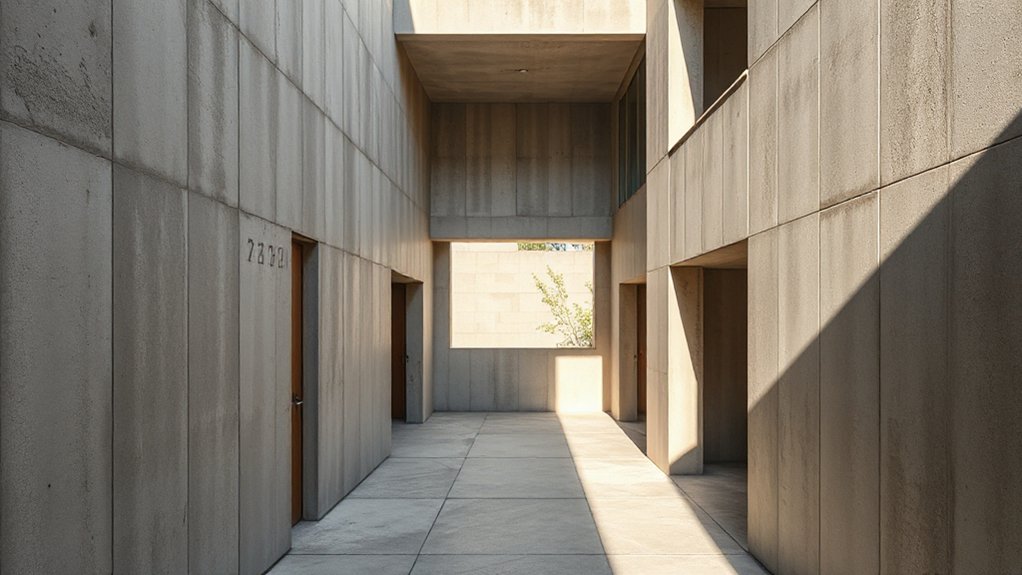
Raw Concrete’s momentum in 2026 stems from a convergence of durability, sustainability, and aesthetic honesty. You perceive why the material resonates now: its resilience fits ongoing demand for timeless infrastructure, while its low environmental impact aligns with shifting regulations and consumer expectations.
You recognize that its raw texture supports versatile fabrication, enabling precise detailing without sacrificing character. The appeal extends beyond utility; it embodies artistic expression, inviting designers to articulate form through texture, contrast, and light.
You also note cultural significance, as exposed materials evoke authenticity and local craftsmanship, linking contemporary projects with historical materiality. In this momentum, you see steadily increasing adoption in commercial and cultural sectors, driven by performance metrics, lifecycle considerations, and a growing appetite for honest, enduring design.
What Raw Concrete Is: Fundamentals for Homeowners
Raw concrete is a structural material that remains exposed, celebrated for its durability and honest expression.
As a homeowner, you’ll want to understand its composition, curing behavior, and how finish choices affect appearance and performance over time.
This overview lays out the fundamentals you need to know to evaluate, specify, and maintain raw concrete in living spaces and exterior applications.
What Raw Concrete Is
Concrete that hasn’t been finished or coated is considered raw concrete. You’re examining a material defined by texture, tone, and exposure rather than disguise.
Raw concrete comprises cementitious binder, aggregates, and water that cure into a solid, inert matrix. Its appearance ranges from smooth to pitted, revealing formwork lines, aggregate variations, and subtle color shifts.
Structural purpose meets aesthetic honesty when you choose this finish, demanding awareness of environmental exposure, moisture movement, and long-term maintenance.
Historical context matters; concrete’s evolution from utilitarian infrastructure to expressive interior surfaces informs expectations and design choices.
Cultural influence shapes how you perceive its honesty, durability, and industrial charm. Understanding these factors helps you anticipate performance, costs, and integration with lighting, textures, and furnishings.
Fundamentals for Homeowners
What should homeowners know about raw concrete to make informed decisions and sound maintenance plans? Raw concrete presents a durable shell, but its behavior varies with mix design, finishing, and environmental exposure. You should understand curing, sealing, and surface porosity to anticipate moisture control, efflorescence, and staining risks.
Regular inspections help detect microcracks early and prevent escalating repairs. Historical context informs aesthetic goals and durability expectations, while Cultural influences shape preferred textures, color, and integration with surrounding materials.
Develop a maintenance calendar that aligns with climate, occupancy, and use, prioritizing sealing schedules and ventilation practices. Choose compatible coatings or sealers, and document performance over time to guide future renovations.
With these fundamentals, you’ll balance performance, style, and long-term value in your raw concrete project.
Durability and Climate Resilience: Quick Metrics
Durability and climate resilience can be assessed quickly through a few core metrics that quantify a material’s performance under environmental stress. You evaluate compressive strength, modulus of durability, and freeze-thaw resistance to establish baseline viability for year-round exposure.
Heat gain, moisture migration, and carbonation potential provide early indicators of long-term stability, guiding preventive strategies. Data from accelerated aging tests offer comparative benchmarks across mixes and admixtures, enabling targeted material selection.
Historical context informs expectations about performance under historic climate variability, while cultural influences shape acceptable risk tolerance and maintenance routines.
You should document service life projections and anticipated repair cycles to support lifecycle planning. This concise metric set supports disciplined decision-making without overreliance on anecdotal evidence.
The Look and Feel: Texture, Patina, and Lighting
Texture, patina, and lighting define how raw concrete communicates with occupants and surroundings, translating measurable durability into perceptible character. You experience texture as a tactile signature of mass and restraint, where grain, tool marks, and micro-variations reveal process and time.
Patina evolves with exposure, weather, and use, signaling provenance and lived memory without deliberate embellishment. Lighting should be considered as a sculptural instrument, casting deliberate shadows that emphasize form while soft rendering surfaces to reveal subtle tonal shifts.
This combination supports artistic expression by offering a disciplined canvas for personal interpretation within architectural restraint. Cultural symbolism emerges through material honesty, where raw concrete anchors identity and sense of place, aligning modern interiors with traditional material narratives while maintaining rigorous, precise clarity.
Concrete Finishes: Bare vs Coatings and Color Options
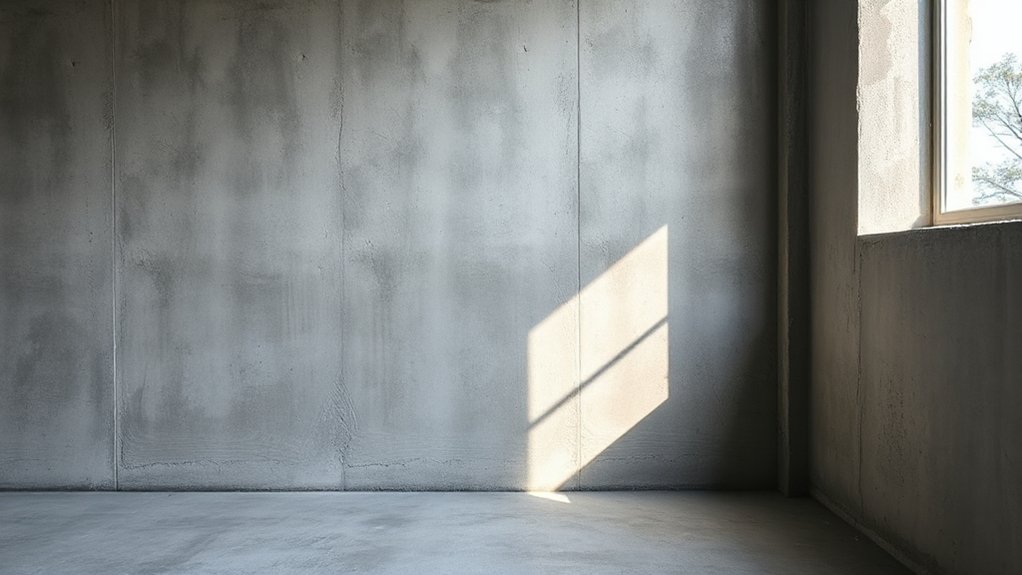
You weigh the impact of bare concrete versus coatings and color options, recognizing how texture, tone, and maintenance shape long-term performance.
Coatings offer control over reflectivity, protection, and aesthetics, while bare concrete preserves a raw, timeless aesthetic with its unique patina.
This discussion weighs practicality against design intent, guiding you to select finishes that align with climate, use, and the room-to-room narrative of your home.
Bare Concrete Aesthetic
Bare concrete delivers a crisp, industrial aesthetic that emphasizes natural texture and honest materials. You evaluate this finish by its unadorned surfaces, visible aggregates, and consistent tonal range, which together convey restraint and purpose.
In this Bare Concrete Aesthetic, you acknowledge how the material’s honesty supports design clarity, letting form and function speak without distraction. You’ll find that the texture can read as a canvas for light—shadow, grain, and patina evolve with time, enhancing rather than concealing architectural intent.
Artistic expression emerges through restrained detailing, deliberate openings, and carefully chosen furnishings that complement the material’s gravity. Cultural symbolism appears in its durability, honesty, and utilitarian pedigree, elements that invite reflection rather than ornamentation.
Consequently, this finish supports a disciplined, lasting architectural narrative.
Coatings And Color Options
Epoxies, polyurethane, and cementitious renders provide robust protection, while limewash and breathable stains encourage nuance in tone without compromising moisture management. You weigh lightfastness, UV resistance, and maintenance schedules against desired aesthetics to achieve lasting results.
When selecting color, consider contrast with surrounding materials to influence perceived scale and warmth. Artistic expression becomes deliberate, not decorative, as you coordinate texture with light and form.
Historical preservation considerations guide choices that respect context while enabling modern performance, ensuring coherence within the architectural narrative.
Embodied Carbon and Sustainability: Making Better Choices
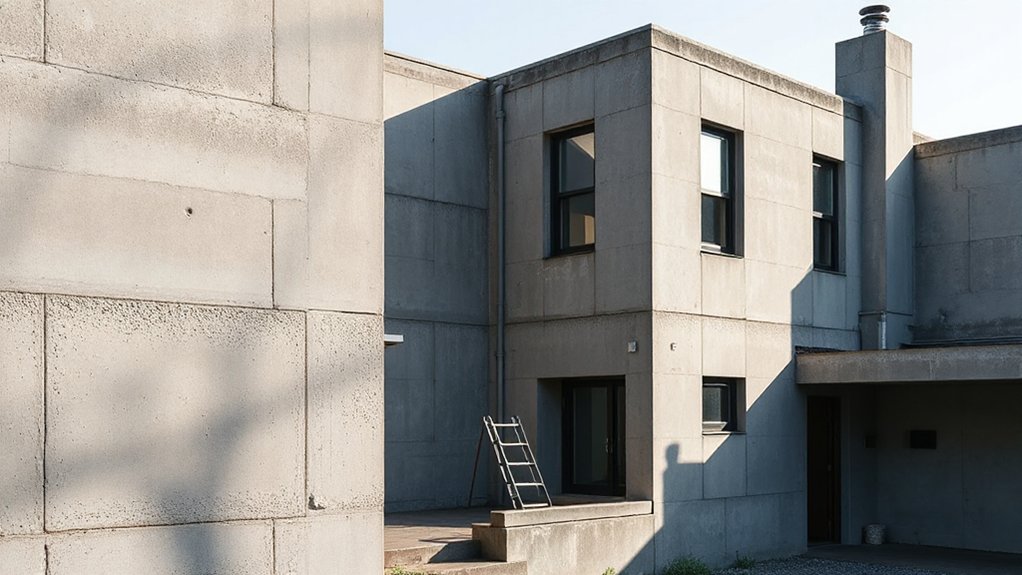
Embodied carbon fundamentally shapes a building’s environmental footprint, so choosing materials and methods with lower embodied energy yields meaningful, long-term sustainability gains. You assess options through life-cycle thinking, prioritizing durable, low-impact materials and efficient design.
Historical context and cultural influences inform material choices, guiding how form meets function without excess. You balance performance, cost, and availability to minimize waste and transport emissions.
- Select low-embodied-energy concrete alternatives and recycled aggregates
- Employ modular designs to reduce on-site waste
- Prioritize regional sourcing to cut transport emissions
- Opt for durable finishes with minimal maintenance
- Invest in deconstruction-planning for future reuse
For Builders: Practical Installation Considerations
You’ll begin with meticulous concrete subfloor preparation to guarantee a stable, vibration-free base.
Plan moisture management strategies upfront, selecting barrier systems and control methods that suit your climate and use case.
Finally, adopt proven fastening and sealing methods to achieve durable performance and consistent finish quality.
Concrete Subfloor Preparation
Before you begin, make certain the existing subfloor is clean, dry, and structurally sound, with all protrusions removed and any loose or damaged sections repaired. You must assess flatness, identify deviations, and plan leveling accordingly to guarantee a stable base for concrete aesthetics.
Thoroughly remove dust, oils, and contaminants that could hinder adhesion, and verify fastening systems are secure. Use appropriate mechanical abrasion or chemical cleaners as required, and conduct moisture tests if applicable.
Address structural joints and potential movement to prevent crack propagation. Ensure proper ventilation and safety measures during preparation.
- Inspect for flatness and tolerances
- Remove contaminants and debris
- Pinpoint and repair defects
- Plan leveling or grinding as needed
- Verify substrate readiness for installation challenges
Moisture Management Strategies
Effective moisture management begins with verifying that the subfloor remains dry and stable after surface preparation. You should establish a continuous monitoring plan, employing accurate moisture sensors, periodical checks, and documented readings to detect shifts before installation proceeds.
Consider a layered approach: vapor barriers, proper slope, and perimeter drainage, ensuring any detected moisture is addressed promptly. Maintain consistent environmental conditions during curing to prevent differential movements that compromise flatness and adhesion.
Historical context informs best practices, highlighting evolving barrier materials and installation sequences that reduce capillary rise and condensation risk. Your strategy must align with structural tolerances and material specifications, while permitting straightforward inspections.
Artistic interpretations matter only insofar as they influence acceptable finishes; focus remains on reliability, repeatability, and long-term performance.
Fastening And Sealing Methods
To guarantee reliable fastening and sealing in concrete assemblies, implement a methodical sequence that optimizes bond strength and environmental durability. You’ll verify substrate conditions, select compatible fasteners, and apply moisture-aware sealants to sustain long-term performance within an architectural framework that values artistic expression and historical context.
- Assess substrate moisture and temperature prior to installation
- Choose corrosion-resistant fasteners with appropriate embedment
- Use compatible sealants and gaskets, compatible with concrete
- Apply surface preparation steps to maximize adhesion
- Inspect joints for uniform compression and cure during curing cycles
These steps ensure precise alignment, minimize thermal movement risks, and preserve the building’s aesthetic integrity.
You’ll document material compatibility, installation tolerances, and performance criteria, reinforcing a rigorous, historically informed approach to contemporary fastener and sealant practice.
Maintenance Realities: Sealing, Cracking, and Care Routines
Maintenance realities for a raw concrete home demand clear, proactive routines. You manage sealing intervals, inspect joints, and address minor cracks before they widen, using evidence-based methods aligned with historical trends and material science insights.
Sealing protects surface porosity, reduces moisture ingress, and minimizes staining; select compatible sealers and recoat per product recommendations.
Cracking reflects stress patterns, curing history, and environmental cycles, so you document movements and monitor progression with precise measurements.
Care routines emphasize cleanliness, timely repairs, and ventilation considerations to prevent efflorescence and mold risk.
Maintain sustainable finishes by avoiding harsh abrasives and enabling breathable coatings where appropriate.
You’ll benefit from baseline maintenance calendars rooted in material science data, updating practices as new performance data emerges, ensuring durability, aesthetic integrity, and predictable long-term behavior.
Budget Dynamics: Upfront Costs and Long-Term Value
Upfront cost tradeoffs set the initial budget trajectory you must manage, balancing material choices, labor, and timing against your project’s constraints.
Long-term value metrics then guide whether higher upfront investments yield durable performance, reduced maintenance, and sustained energy efficiency.
Upfront Cost Tradeoffs
What tradeoffs arise when you balance upfront costs against long-term value in a raw concrete home? You assess initial expenditures against durability, maintenance, and energy performance over time. Upfront investments can reduce life-cycle costs, while leaner builds may maximize liquidity but raise future spending.
Strategic choices—material sourcing, labor efficiency, and passive design—shape payback periods and resale appeal. You should quantify payback horizons and risk exposure to market shifts, ensuring alignment with your financial plan and risk tolerance. The goal is predictable operations, not just lower initial price.
Consider how upfront decisions influence construction speed, permitting, and upfront financing terms, then balance them against projected running costs and comfort.
- Balance upfront cost vs. ongoing savings
- Evaluate financing terms and liquidity impact
- Assess maintenance and repair frequency
- Compare energy efficiency gains
- Align choices with lifestyle goals and destinations, Cooking tips, Travel destinations
Long-Term Value Metrics
Concrete’s durability lowers long-run replacement needs, but require proper detailing, joints, and sealants to prevent moisture ingress and thermal bridging.
You weigh ongoing savings from thermal mass, fire resistance, and low operating energy against potential retrofitting costs as standards evolve.
Artistic expression informs form and texture without sacrificing performance, while Cultural symbolism can elevate perceived value through enduring material narrative.
Documented performance histories and independent evaluations strengthen trust with buyers and lenders.
Align design decisions with lifecycle analyses to optimize total cost of ownership and long-term market appeal.
Design Versatility: Spaces and Lifestyles That Fit Concrete
Design versatility arises from how concrete can define both spaces and lifestyles with equal clarity. You explore how raw materials shape room proportions, acoustics, and light, delivering a cohesive, disciplined aesthetic that remains adaptable. Your choices support varied uses, from quiet studios to open-plan family zones, without sacrificing structure or temperament.
This versatility enables artistic expression within restrained forms, while cultural influence informs texture, color, and finishes to align with local context. You’ll maintain durability without compromising refinement, and you’ll plan routines around robust surfaces that age with dignity. The result is spaces that respond to changing needs, tastes, and functions over time.
- Harmonized scales and material honesty
- Flexible zoning for work, living, and leisure
- Minimal maintenance with maximum resilience
- Texture-driven warmth without ornament
- Contextual cues shaping identity and atmosphere
Real-World Cases: Homes Embracing Raw Concrete
Real-world homes that embrace raw concrete demonstrate how this material can balance restraint with comfort. You observe projects that pair exposed structure with refined interiors, proving durability need not abandon warmth.
In many instances, designers reference historical context to justify legible, enduring finishes, aligning material honesty with anticipated lifecycles. You see concrete’s tactile grain, subtle patinas, and modular detailing that age gracefully, reducing ongoing maintenance while preserving clarity of form.
Cultural influence emerges in courtyard concepts, texture interplay, and spatial zoning that respect local traditions yet express contemporary minimalism.
You notice scalable solutions—from single-family residences to adaptive-use structures—that prioritize durability and material honesty. This practical evidence informs decisions about cost, performance, and long-term viability for prospective homeowners seeking permanence.
Indoor Climate: Maintaining Air Quality and Humidity
Maintaining indoor air quality and stable humidity is essential for comfort, health, and the longevity of a raw concrete environment. You should monitor ventilation rates, humidity controls, and filtration to prevent dampness and particulates from affecting finishes and occupants.
Proper detailing supports sustained air quality, while consistent, data-driven adjustments optimize comfort without compromising design intent. Landscape design considerations around ventilation paths and plant emissions influence indoor conditions, so assess exterior factors as you specify interior systems.
Exterior facades also impact thermal loads that drive humidity swings; integrate performance metrics into your building envelope strategy for stable comfort.
Focus on focused maintenance, smart sensing, and balanced airflow to keep the space healthy and visually coherent with the raw aesthetic.
- Monitor ventilation, filtration, and humidity levels regularly
- Align conditioning with occupancy patterns and activities
- Integrate landscape design influences into ventilation planning
- Consider exterior facades in thermal load management
- Schedule proactive maintenance and sensor calibration
Comparing Materials: Raw Concrete vs Alternatives
Raw concrete offers a distinct aesthetic and structural behavior that sets it apart from common alternatives; you should assess its benefits and drawbacks against other materials regarding appearance, durability, and environmental impact.
When comparing options, you weigh texture, color stability, and long-term maintenance alongside upfront costs. Concrete delivers a tactile, honest surface that supports artistic expression through intentional forms and finishes, yet it requires careful detailing to control cracking and moisture movement.
Alternatives like timber, brick, or steel bring warmth, lighter embodied energy, or modular versatility, but may compromise neutrality or durability in specific climates.
Consider surface treatments and protective coatings to expand durability and control texture. Ultimately, decision-making hinges on performance goals, lifecycle costs, and the project’s environmental footprint.
Is 2026 the Tipping Point for Mainstream Adoption?
The momentum toward mainstream adoption of raw concrete in 2026 hinges on a convergence of performance, cost, and sustainability signals that builders and clients increasingly weight. You assess whether early gains translate into durable market share, guided by evidence of reliability, lifecycle cost, and project logistics that shape decision making.
Historical influence and Cultural significance frame expectations, informing design vocabularies and stakeholder narratives. If benchmarks align, adoption accelerates across residential and commercial sectors, with standardized detailing and safer sourcing.
You should monitor policy shifts, supply chain stability, and training ecosystems, all of which affect feasibility. The tipping point depends on consistent outcomes, not novelty, as perception shifts from curiosity to common practice.
- Performance parity with established methods
- Economies of scale and predictable pricing
- Certification and code alignment
- Skilled workforce availability
- Cultural acceptance and heritage dialogue
Frequently Asked Questions
How Soon Could Raw Concrete Be Cost-Effective for Homeowners?
Raw concrete could be cost-effective within 5–15 years, depending on labor and material costs. You’ll see a favorable cost comparison as durability reduces maintenance, while Material durability justifies higher upfront investment over time.
Are There Health Concerns With Raw Concrete Indoors?
Concern about indoor air quality is valid: yes, there are health concerns with raw concrete indoors. Avoid concrete dust exposure; use proper ventilation, containment, and PPE to minimize respiratory irritation and long-term effects.
Can Raw Concrete Blend With Traditional Aesthetic Styles?
Yes, raw concrete can blend with traditional aesthetics if you apply decorative finishes and complementary materials. You’ll achieve a balanced, timeless look that respects historical aesthetics while preserving the industrial character, enhancing sophistication and architectural coherence throughout your space.
What Maintenance Costs Accompany Yearly Repairs?
Maintenance for yearly repairs varies, but you’ll typically budget for sealant refreshes, joint inspections, and structural checks, with interior decor updates and environmental impact considerations influencing frequency and cost.
Will Insurance Cover Raw Concrete Homes in Extreme Weather?
Insurance policies vary, but coverage for raw concrete homes in extreme weather can be included or excluded; you should review limits, endorsements, and exclusions. You’ll want precise terms, and confirm protections against flood, wind, and seismic risks during extreme weather.
Conclusion
As you read, you’ll doubt you’ll ever tire of raw concrete’s “timeless” charm. It’s rugged, affordable, and frankly, everywhere—yet somehow still exclusive enough to seem avant-garde. The irony? Its minimalism demands more judgment calls, not less, from owners and builders. If 2026 prodigiously heralds mass adoption, don’t pretend you’re surprised by the crowd. The look persists, the climate begs for control, and yet, somehow, we all pretend it’s a disciplined choice, not a fashionable compromise.