
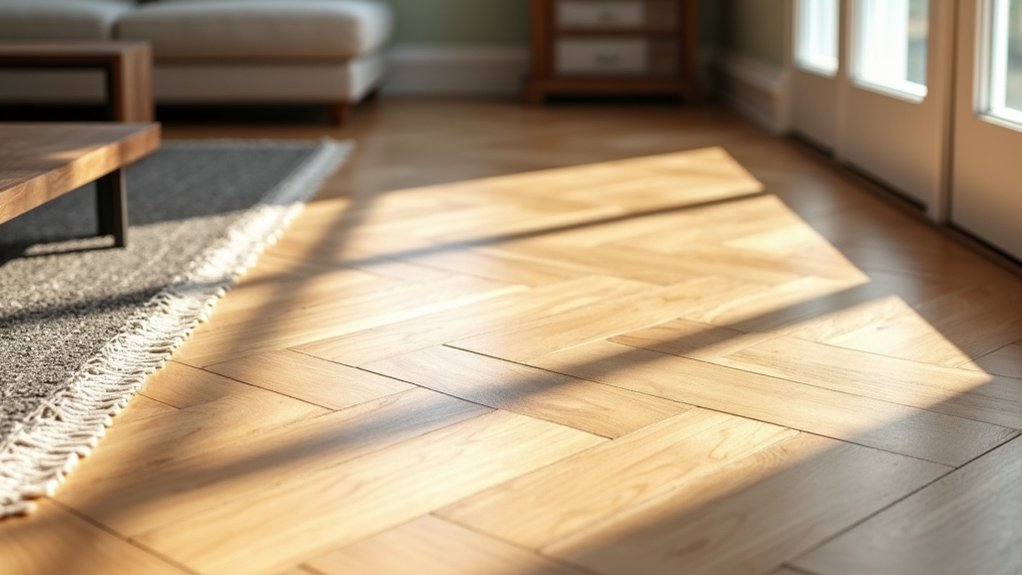

Parquet laminate flooring combines a durable laminate core with parquet-inspired patterns to deliver the look of real wood with controlled performance and moisture resistance. You’ll get layered construction: wear layer, design layer, core, and an underlayment for stability and acoustics. It’s available in wide or intricate patterns, with various finishes and textures. Durable, cost-efficient, and easier to install than solid wood, it’s suitable for controlled-moisture spaces. If you continue, you’ll uncover installation tips and maintenance essentials.
Parquet Laminate Explained
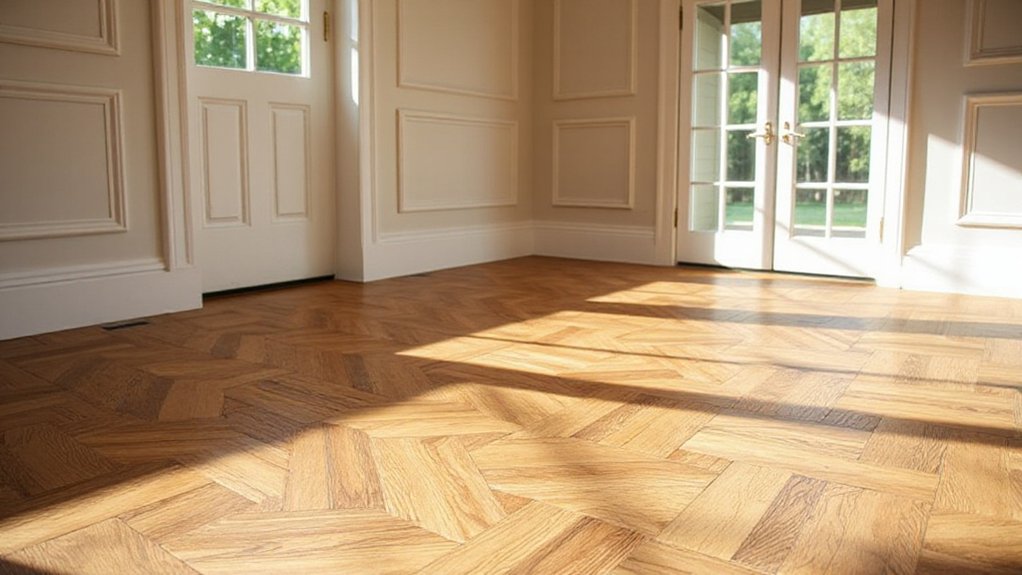
Parquet laminate is a high-density composite flooring option that mimics traditional parquet patterns with a durable laminate core. You install sections that combine small, geometric veneer visuals with a scratch-resistant surface, delivering a classic look without real hardwood maintenance.
This product uses a multilayer construction: a wear layer, a printed design layer, and a balancing or core sheet, all bonded under pressure. You benefit from stable dimensions, excellent resistance to dents, and straightforward cleanup.
Eco friendly options exist through formaldehyde-free or low-emission cores and sustainable sourcing.
For installation, you rely on specific installation tools and techniques, including tapping blocks, spacers, and alignment guides, to achieve tight joints and uniform patterns. Precision layout minimizes disruptions, while underlayment supporting moisture control and acoustic performance optimizes long-term stability.
Is Parquet Laminate Right for You?
If you’re weighing options for your space, parquet laminate can be a strong fit when you want a classic pattern without the upkeep of real hardwood. You should consider how this option aligns with foot traffic, humidity levels, and maintenance expectations.
Parquet patterns offer visual variety in small or large areas, yet the look remains uniform with consistent plank dimensions. Color options influence room brightness and perceived space, so pick tones that complement your existing décor and lighting.
From a performance standpoint, verify your space supports stable subflooring and a proper underlayment to minimize wear.
Installation tools compatibility matters; verify that your chosen system uses straightforward locking mechanisms and requires common tools.
If ease of replacement matters, note that individual tiles can simplify localized repairs.
Core Laminate Construction Layers
The core board provides rigidity and dimensional stability, reducing expansion from moisture and temperature swings. The overlay adds scratch resistance and minimizes denting, while the wear layer shields decorative patterns beneath.
Engineered underlayment beneath can improve acoustic performance and installation ease. Manufacturing emphasizes Sustainable sourcing, selecting non-wood or certified materials to minimize environmental impact.
Consistency across panels matters; you’ll notice color consistency between batches, which preserves visual harmony during installation. Together, these layers balance strength, ease of maintenance, and long-term appearance, guiding durable, low-maintenance parquet aesthetics.
Parquet Laminate vs. Real Wood: What to Know

While parquet laminate mimics the look of real wood, it’s built from layered materials designed for durability and stability.
Genuine hardwood is a solid tree product subject to natural variability and refinishability. You compare life-cycle factors by material composition, durability, and maintenance.
Parquet laminate offers predictable performance under moisture and temperature swings, with faster installation and lower cost than solid wood.
Real wood delivers unique grain, potential for deeper refinishing, and higher resale value, but at greater vulnerability to moisture and expansion.
Eco-friendly options depend on certified sourcing and manufacturing practices.
Consider installation challenges: subfloor flatness, underlayment needs, and quick acclimation for laminates.
Balance aesthetics, longevity, and environmental impact to select the option that aligns with your project goals and budget.
Reading Parquet Laminate Specifications
Parquet laminate specifications define how the product behaves under real-world conditions, from core composition to surface finish. You assess durability by core material, wear layer thickness, and locking system reliability.
Look for a balanced wear layer (thickness matters for heavy use), a stable core to resist moisture and movement, and a proven click or tongue-and-groove fit that ensures tight joints.
Finish indicators reveal scratch resistance, stain behavior, and UV stability. Documentation should include tests like shear, impact, and indentation, plus dimensional tolerances for expansion gaps.
Note Parquet laminate history to understand long-term performance trends, and verify claims about eco-friendly materials.
Compare certification marks and installation notes to ensure compatibility with your space, subfloor, and climate before purchasing.
Pros: Style, Cost, and Quick Installs
Parquet laminate offers notable advantages in style, cost, and speed of installation. You’ll appreciate how this flooring delivers a refined look without the price tag of solid wood, benefiting from durable wear layers and a fast, glue-free or minimalistic click installation.
Style versatility comes from patterns that mimic traditional parquet layouts, with modern consistency and repeatable results.
Cost efficiency stems from material availability, reduced waste, and quicker on-site timing, which lowers labor costs.
Quick installs translate to less disruption and faster project completion.
Eco friendly options exist through recycled or rapidly renewable core materials, and you can achieve custom patterns by selecting plank sizes, grain orientations, and inlays.
This combination supports tailored aesthetics while maintaining performance and value.
Cons: Where Parquet Laminate May Fall Short

Parquet laminate offers style and quick installation, but you’ll trade some durability for those benefits. You’ll face durability trade-offs and potential wear in high-traffic areas, plus heightened maintenance demands to keep the surface looking uniform.
This section flags where those trade-offs matter so you can weigh long-term performance against upfront convenience.
Durability Trade-Offs
- Impact resistance may decline on hard subfloors or during accidental drops.
- Abrasion resistance varies by finish and underlayment quality.
- Moisture sensitivity can offset structural stability in damp environments.
- Repair options are limited compared to solid wood alternatives.
You’ll notice that performance hinges on finishing density and substrate integrity, not just the top layer.
In high-traffic settings, you should prioritize thicker wear layers and high-quality coatings.
Consider impact resistance as part of your material selection, balancing aesthetics with functional lifespan.
Anticipate delamination risks where moisture intrusion occurs.
Maintenance Demands
Maintenance demands can be higher for parquet laminate than some alternatives, and shortcomings emerge when routine care isn’t consistent. You must implement a disciplined maintenance plan to preserve appearance and performance.
Daily cleaning should use a dry or microfiber method to prevent moisture intrusion that can cause warping or seam separation. Promptly address spills, especially on joints, to minimize adhesive swelling and edge lifting.
Periodic deep cleaning with manufacturer-approved cleaners protects wear layers without dulling.
Environmental impact factors matter: excessive refinishing isn’t feasible, so choosing a finish with low volatile organic compounds (VOCs) helps reduce emissions over time.
Allergy concerns are addressed by limiting dust buildup and using high-efficiency filtration in HVAC zones during maintenance.
Inconsistent routines elevate costs and shorten system life, undermining expected environmental and health benefits.
Best Rooms for Parquet Laminate
Parquet laminate is best suited for indoor living areas with moderate foot traffic and stable environments, where its wood-tone pattern adds warmth without sacrificing durability. You’ll choose rooms where moisture is controlled and layout supports straight plank runs. This minimizes swelling and guarantees consistent color across panels.
Consider spaces that benefit from visual cohesion and easier maintenance, without exposure to heavy impacts. For color options and installation tools, select tones that complement cabinetry and furniture while keeping wear patterns discreet. Manage transitions between rooms with precise underlayment and trim. Use tools that guarantee tight seams and uniform alignment.
- Stable entryways and living rooms
- Home offices with minimal humidity swings
- Formal dining areas with moderate foot traffic
- Bedrooms requiring quiet, low-traffic paths
- Hallways with controlled moisture exposure
Aesthetic Options: Patterns, Finishes, Textures
Aesthetic options for parquet laminate focus on how patterns, finishes, and textures influence room perception, durability, and maintenance. You’ll evaluate color options to harmonize with existing decor or create contrast, considering light reflection and wear resistance.
Pattern variety drives its visual impact; intricate inlays can read formal, while wide-plank arrangements appear expansive and modern. Finishes determine sheen, scratch tolerance, and cleaning needs, with matte reducing glare and gloss highlighting fingerprints.
Texture choices—from smooth to embossed—alter perceived depth and footprint; grip, sound, and maintenance vary accordingly.
Durability hinges on layer quality, wear layer thickness, and adhesive stability under foot traffic. Finally, guarantee colorfastness and fade resistance align with lighting exposure; select patterns that balance practicality with design intent for long-term satisfaction.
Key Features to Look for in Parquet Laminate
When selecting parquet laminate, prioritize core construction details that impact performance and longevity. You’ll assess core material quality, wear layer thickness, and edge integrity to guarantee durability, moisture resistance, and long-term stability.
Consider a balanced combination of strength, stability, and ease of maintenance. Historical evolution informs material choices and performance benchmarks, guiding you toward proven specifications.
Environmental impact matters too, so review production practices and recyclability.
- Core construction quality and thickness
- Wear layer thickness and durability
- Surface finish hardness and scratch resistance
- Edge sealing and moisture tolerance
- Environmental impact considerations and lifecycle data
Installation Overview: Floating Floors and Click-Lock
Floating floors with a click-lock system offer quick, tool-free installation that you can perform with minimal subfloor preparation. You’ll align planks end-to-end using precise tongue-and-groove connections, ensuring a tight fit without glue or nails.
Acclimate material to room conditions per manufacturer guidance to prevent cupping or gaps after installation.
Maintain a consistent expansion gap around the perimeter to accommodate moisture and temperature changes.
Begin in a straight, square line, then stagger joints to create a stable, natural-looking layout.
Use spacers to preserve gaps near walls, and avoid forcing planks into misaligned rows.
Color coordination across planks is essential for a uniform appearance, while furniture placement should account for traffic patterns and doorways to minimize wear.
Finish with a protective underlayment and changeover trims for a clean edge.
DIY Tips to Avoid Common Mistakes
Even with a click-lock system, small setup mistakes can undermine performance; here are targeted tips to prevent them.
- Inspect planks for defects and color consistency before installation, choosing eco friendly options when possible.
- Dry-fit rows to confirm alignment, staggering seams for natural texture and color customization.
- Acclimate materials in the room per manufacturer guidance to avoid expansion or contraction.
- Maintain even moisture and temperature; maintain a consistent subfloor flatness to reduce gaps.
- Use clean, soft tools and avoid excessive force that could damage tongue-and-groove joints.
Underlayment, Moisture Barriers, and Sound
Consider underlayment options that reduce flex and provide uniform support to minimize edge chipping and hollow sounds. For concrete slabs, moisture barriers are essential; select a product rated for your site’s humidity and vapor drive, especially in basements or climates with high groundwater risk.
If your subfloor is wood or plywood, guarantee compatibility with your laminate and prior coatings to prevent staining or delamination. Acoustic performance matters; prioritize materials that deliver measurable sound reduction without complicating installation.
Always verify panel tolerance, seams, and perimeter gaps to maintain a consistent, stable surface.
Maintenance Essentials: Cleaning and Longevity
Maintaining parquet laminate flooring hinges on regular cleaning habits and proactive longevity measures. You protect its appearance and performance by targeted maintenance routines that minimize damage and preserve color variation consistency.
Use proper tools and technique to avoid scratches while ensuring even wear over time. Regular dusting, light mopping with a damp, not wet, microfiber pad, and immediate spill cleanup prevent residue buildup and warping.
Avoid harsh cleaners, waxes, and steam machines that can degrade the finish. Schedule periodic inspections of edges and joints, addressing loose planks with appropriate installation tools to prevent gaps.
Protect from direct sunlight to minimize color variations. Use felt pads under furniture and area rugs to distribute impact loads evenly.
Prioritize these practices to extend beauty and stability.
- Color variations
- installation tools
- Regular dusting
- Damp mopping
- Protective hardware
Longevity and Wear: Typical Lifespans
Longevity and wear in parquet laminate flooring depend on the product grade, wear layer thickness, and the quality of installation. You should expect typical lifespans that reflect these variables, with higher-grade materials and thicker wear layers lasting longer under normal use.
In high-traffic areas, a robust wear layer provides improved resistance to surface scratches and denting. Proper installation reduces gaps and moisture intrusion that can accelerate aging.
Maintenance habits influence longevity as much as material quality, so follow manufacturer guidelines for cleaning and seasonal checks.
Eco-friendly options exist, but balance environmental goals with performance expectations to avoid compromising durability.
Installation challenges, including precise acclimation and subfloor preparation, directly affect wear patterns and edge stability.
Choose products that align with your budget, traffic, and flooring system compatibility.
Cost Considerations: Materials, Underlayment, Pros vs. DIY
When evaluating parquet laminate flooring costs, start with materials and underlayment, then weigh the practical trade-offs of DIY installation versus professional setup.
You’ll perform a precise cost analysis by comparing core options, wear layers, and core materials, then factor underlayment type for moisture control and comfort.
Material comparisons reveal how thickness, finish, and locking systems affect long-term value and installation speed.
Consider warranty coverage, footfall suitability, and substitution risks before committing.
- Cost analysis: upfront vs. long-term savings
- Material comparisons: thickness, core, finish
- Underlayment: moisture, sound, and comfort
- DIY vs. professional: labor, accuracy, and downtime
- Total cost, maintenance needs, and resale value
Estimating Square Footage and Waste
Calculate linear footage for each wall if you’re planning borders or patterns, ensuring you account for transitions and doorway openings. Round measurements to the nearest inch, then convert to square feet, subtracting fixed features like cabinets where appropriate.
When choosing parquet patterns, consider color coordination and how it affects waste; darker tones may reveal miscuts more readily, while lighter flooring textures can mask minor errors. Document your total square footage, then purchase by the recommended packaging size to minimize offcuts and redundant material.
Troubleshooting Common Issues: Gaps, Squeaks, Warping
Gaps, squeaks, and warping are common parquet laminate issues that undermine stability and appearance, but they’re usually fixable with systematic inspection and targeted adjustments. You’ll diagnose causes, then implement precise corrections to restore alignment and reduce movement.
- Gaps adjustment: re-align edge seams and reseat panels with controlled tapping.
- Inspect for loose boards and subfloor irregularities, then reseat or replace as needed.
- Squeak prevention: locate high-friction joints and apply thin underlayment or adhesive where appropriate.
- Secure loose perimeter trim to minimize plank shifting.
- Verify humidity and temperature stays within specification to protect dimensional stability.
Finishing Touches and Timeless Care for Parquet Laminate
Finishing touches and ongoing care for parquet laminate center on protecting stability and preserving appearance through precise maintenance. You implement routine cleaning that avoids excess moisture and harsh abrasives, directing attention to joints and high-traffic zones. Use a microfiber pad and manufacturer-approved cleaners to reduce sheen loss and edge lifting.
When selecting finishes or topcoats, prioritize compatibility with existing planks and environmental impact. Schedule periodic inspections for wear patterns, ensuring fasteners and connections remain secure.
Color trends influence refinishing choices, guiding subtle updates that preserve value without disrupting layout. Eco-friendly options, including low-VOC cleaners and water-based sealants, minimize indoor emissions while maintaining performance.
Establish a preventive calendar, record observations, and enact timely repairs to sustain stability, durability, and a consistent, professional appearance.
Frequently Asked Questions
Can Parquet Laminate Be Refinished or Only Replaced?
Parquet laminate can be refinished only to a limited extent; its refinishing potential depends on wear, thickness, and substrate. If damage is extensive, Replacement considerations favor replacement. Assess wear layers, platter thickness, and warranty before deciding.
How Does Humidity Affect Parquet Laminate Lifespan?
Humid conditions stress parquet laminate like a drumbeat: humidity fluctuations accelerate wear, reducing lifespan. You’ll see material expansion with moisture, followed by contraction; this cyclic movement loosens joints and delaminates layers, so monitor humidity to preserve performance and longevity.
Are There Eco-Friendly Parquet Laminate Options?
Yes, you can find eco-friendly parquet laminate options. Choose sustainable materials and eco friendly finishes, verify third-party certifications, and prefer low-VOC adhesives to minimize emissions while sustaining performance and durability in high-traffic environments.
What Warranty Coverage Comes With Parquet Laminate?
Your warranty typically covers manufacturing defects for 15–25 years, with limited terms on wear, finish, and moisture damage. Care and maintenance can affect claims. Cost comparison matters for coverage upgrades, so review exclusions, registration, and local requirements carefully.
Can Parquet Laminate Be Installed Over Existing Flooring?
Yes, you can, but you must verify subfloor preparation and installation challenges first. You’ll address uneven surfaces, moisture, and underlayment compatibility, ensuring subfloor preparation is thorough to prevent gaps, buckling, or premature wear during parquet laminate installation.
Conclusion
Imagine stepping onto a mosaic of light and shadow, each parquet tile clicking into place like a precise puzzle. You’ve navigated spec sheets, gaps, and underlayment choices, forging a durable, stylish surface. Parquet laminate blends engineered stability with timeless patterning, resisting warps and wear when installed correctly. With proper maintenance, your floors stay crisp and inviting, echoing craftsmanship. In short: technical reliability meets elegant texture, guiding your space toward enduring charm and functional resilience.