


Did you know most apartments with limited windows feel up to 30% darker than similar spaces with better light? You can counter that by using light-colored walls, reflective surfaces, and mirrors opposite existing windows to bounce daylight deeper in. Layer ambient, task, and accent lighting with warm LEDs and dimmers for mood control. Ready to transform your space without a complete overhaul? Keep going to learn practical setups and budget-friendly tweaks.
Foundational Brightness for Small-Window Apartments
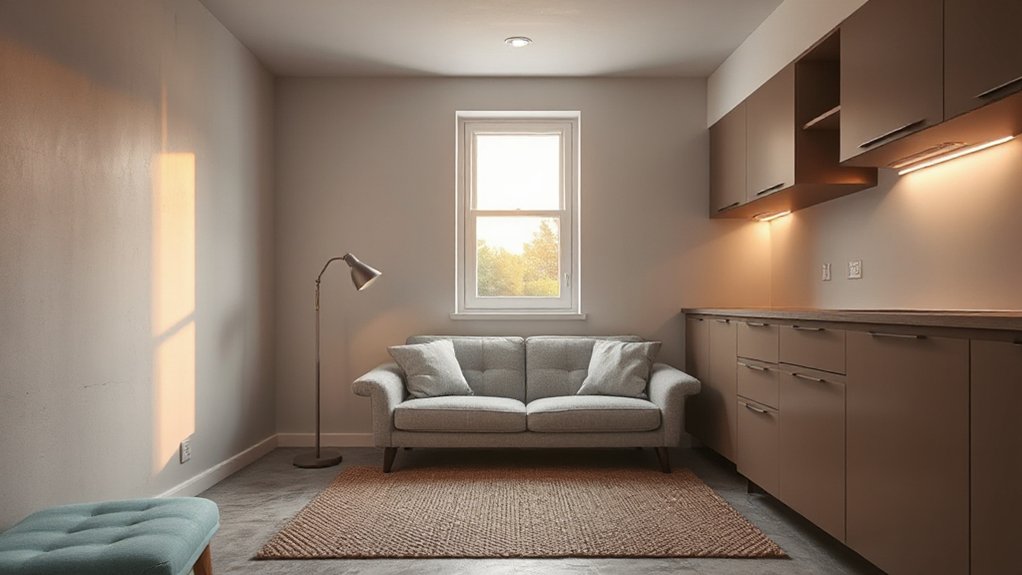
When you’re lighting a small-window apartment, the goal is to maximize perceived brightness without crowding the space. Start with a neutral palette, then choose fixtures that emit diffuse, even light.
For natural illumination, place mirrors opposite windows to bounce daylight deeper into rooms while avoiding glare. Select light-colored walls and reflective surfaces to amplify reflected light, not just added fixtures.
Use window treatments that open fully and stay out of sight when not needed, such as slim roller shades or louvered panels, so daylight remains unobstructed.
Favor compact, low-profile sconces and recessed LEDs that don’t loom over furniture. Track lighting can flex with layouts, but keep wall-mounted units aligned to avoid crowded ceilings.
Prioritize brightness consistency; avoid hotspots by spacing sources evenly.
Layered Lighting: Ambient, Task, and Accent in Tight Spaces
Layered lighting in tight spaces means using three overlapping layers—ambient, task, and accent—so a small apartment feels bright without clutter. In practice, balance is key: ambient fills the room evenly, task focuses light where you work, and accent highlights architectural features.
Begin with a central ceiling fixture that provides soft, consistent color temperature for general visibility. Add wall or floor lamps near seating to prevent shadows, and place under-cabinet or desk lights for precise task lighting.
Think fixture placement to avoid glare on screens and to maintain open sightlines. Use cooler temperatures for work zones and warmer tones for living areas; switch zones with dimmers to control mood.
Pair layered layers with smart controls for reliable, flexible daily routines.
Choosing Warm LEDs for a Welcoming Glow
Choosing warm LEDs is your first step to a welcoming glow you can feel. Aim for color temps around 2700–3000K and review CRI to guarantee comfortable skin tones.
While doing so, also note wattage and lumen output for the space you’re lighting. Consider where warm light will soften edges and enhance textures in your apartment.
Then test a few fixtures to confirm the warmth meets your needs.
Warmth From LEDs
LED warmth isn’t just about color; it’s about how the light feels in a space. When you choose warm LEDs, prioritize color temperatures around 2700K to 3000K for a cozy vibe without yellow overload.
Look for high CRI (80+) to preserve true colors, especially in fabrics and wood finishes. Consider dimmable fixtures to modulate mood from work to relaxation.
And opt for layered lighting—ambient, task, and accents—to avoid flatness. For warmth enhancement, select LEDs labeled for stable temperature and low blue emission to reduce fatigue.
Check bulb efficiency and lumen output to balance brightness with energy use. Explore LED innovations like smart-tuning optics and reliable drivers, ensuring consistent color over time.
Pair with warm accent accents for a welcoming, practical setup.
Welcoming Glow Applications
A warm, welcoming glow starts with the right LEDs at the right brightness. You pick color temperatures in the warm range (2700–3000K) to mimic natural daylight and reduce harsh shadows. Use dimmable fixtures so you can tune down for intimate evenings without losing spatial clarity.
Layer light with three levels: ambient, task, and accent. For ambient, choose diffuse ceiling or wall washers; for task, place focused desk or under-cabinet lights where you read or work. Accent lights highlight art or textures without glare.
Consider Natural skylights as inspiration rather than a fixture; mimic their subtle daylight shift with tunable LEDs. If you lack daylight, try Solar powered lamps as flexible, cordless options to maintain a consistent glow throughout the room.
Quick-Win Daylight Hacks When Windows Are Scarce
When you’ve got limited natural light, start with a practical plan: map the sun’s path through your space and prioritize light where you actually spend time. In rooms with scarce windows, place mirrors opposite light sources to bounce daylight, not glare, and keep window treatments minimal on sunny days. Use white or cool-toned walls to maximize reflected brightness and avoid dark corners.
Start with a daylight-first routine: open blinds at peak sun, then layer artificial illumination to extend usable hours. Favor task lighting at desks, counters, and reading nooks, and aim for even distribution to prevent hotspots. Combine ceiling ambient with targeted lamps for depth, ensuring color temperatures align—natural light during the day and consistent artificial illumination at night. Coordinate lampshades and bulbs for cohesive brightness.
Reflective Surfaces That Multiply Light Without Glare
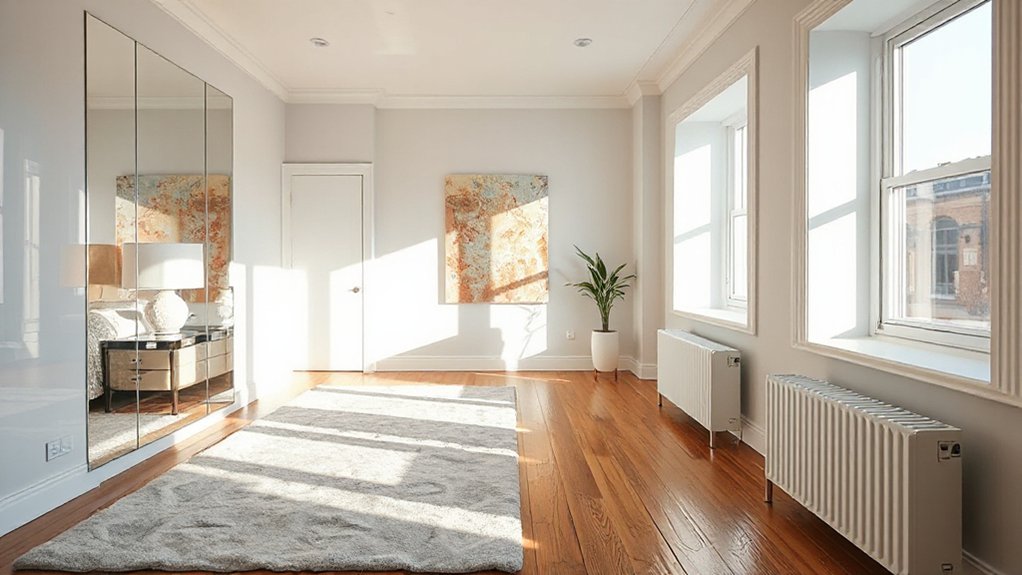
Reflective surfaces can be the secret to brighter apartments without adding glare. You’ll choose finishes that bounce light efficiently without creating hotspots.
Start with matte whites or satin neutrals on walls to diffuse daylight evenly, then layer with strategically placed mirrors to extend the view rather than overpower it. Position a large wall mirror opposite a window to multiply daylight without increasing glare, and use a secondary mirror on a side wall to scatter light toward darker corners.
Opt for glass, brass, or acrylic accents with soft edges to avoid harsh reflections. Keep glare control in mind by aiming light away from seating areas and using diffusers on task lamps.
Select controlled luminance over maximum brightness for a calmer, brighter space.
Color Strategies to Make Rooms Feel Bigger
Color is a powerful tool for making rooms feel bigger, and choosing the right hues can fool the eye into perceived spaciousness. You’ll start with neutral walls in light tones to reflect natural light and create airiness.
Choose color psychology principles: cool neutrals like soft grays, beiges, or pale blues reduce visual weight, while small accent colors should stay limited to accessories to avoid crowding walls.
Maintain consistent saturation across walls; avoid high paint saturation on large surfaces, which can feel overwhelming in tight spaces.
Use white ceilings to lift the top edges and widen sightlines.
Introduce color with purposeful accents—pillow, artwork, or a single rug—so you control focal points without shrinking the space.
Keep progressions seamless to preserve flow and brightness.
Smart and Adjustable Fixtures for Dynamic Mood
Smart Ambience Control lets you tailor lighting scenes with a tap or voice command, so you set the mood without fuss.
Use dimmable layered lighting and you’ll balance task, ambient, and accent light for any activity.
Adapt the color temperature to match the time of day or task, keeping spaces comfortable and focused.
Smart Ambience Control
Smart ambience controls let you tailor lighting to mood and tasks with ease. You can set scenes that adapt to morning routines, workspaces, and relaxation corners without fumbling for switches.
Use smart bulbs or low-profile panels that respond quickly to voice prompts or a central hub, so you don’t interrupt your flow. Prioritize automation integration with your existing systems—smart TVs, speakers, and sensors—to adjust color temperature and brightness based on time of day or occupancy.
Keep hierarchies simple: one bright task light for desks, softer ambient backlighting for evenings, and a neutral, energy-efficient default.
Avoid clutter by linking only essential devices, and test routines weekly to preserve reliability and calm in your apartment ambiance.
Dimmable Layered Lighting
- Define task, ambient, and accent layers for each space
- Pair bulbs with compatible smart controls
- Balance color temperature and brightness
- Create at least one bright, one cozy, and one focused preset
- Test flicker and dimming smoothness across devices
Adaptive Color Temperature
For task work, set cooler temps around 3500K–4500K to sharpen focus and color accuracy. When relaxing or entertaining, switch to warmer 2700K–3000K to soften ambiance and encourage comfort.
Pair adjustments with dimming; brightness and temperature together influence perceived color quality and depth. Plan scenes that preserve color harmony across rooms, so artwork and fabrics read consistently.
This approach supports mood enhancement by aligning light with activity, reducing eye strain, and maintaining a cohesive, apartment-wide lighting narrative.
Lamp Placement to Maximize Perceived Space

Placing lamps strategically can actually make a small apartment feel roomier. You’ll use lamp placement to define zones, bounce light off light-colored walls, and reduce harsh shadows that shrink perceived space.
Position a floor lamp behind seating to widen the area without crowding it, and aim table lamps toward corners to deepen the glow. Choose lighter lamp shades to maximize brightness without glare, and place lighting at multiple heights to create vertical depth.
Use mirrors or glossy surfaces to reflect light, but avoid over lighting the same spot. Dimmer switches give you control during different tasks, preserving perceived space when needed.
- Use a tall floor lamp behind seating to extend the line of sight
- Place table lamps at eye level in working areas
- Angle lights toward walls to bounce light off surfaces
- Layer light with ambient, task, and accent sources
- Keep cords organized to maintain open floor feel
Window-Mimicking Ideas That Fool the Eye
You can start creating a window-like glow with light illusion techniques that brighten walls as if sun spills in. Use strategic mirror and glass placements to bounce light toward dark corners, simulating a window’s reflection and open feel.
Pair color and shadow play with careful intensity to keep the effect natural, avoiding glare while guiding the eye where you want it.
Light Illusion Techniques
One effective way to expand a small apartment is to use light to mimic windows, creating the illusion of outdoor depth. You’ll deploy light illusion techniques that rely on placement, color, and contrast to suggest horizons and daylight shifts.
Focus on natural shadows and light diffusion to sell depth without obvious sources. You’ll calibrate brightness to mimic sun angles, and use warm tones near “windows” while cool tones recede. Avoid harsh edges; blend with soft, layered lighting.
Control glare with matte finishes and indirect fills, and cue intensity with dimmers. Position luminaires to cast long, diagonal shadows across walls and ceilings, enhancing perceived space.
Layer multiple sources at different heights.
Use dimmers to modulate mood and depth.
Create believable horizon lines with soft gradients.
Employ warm-to-cool progression across zones.
Avoid direct reflection on glossy surfaces.
Mirror and Glass Placement
Mirrors and glass surfaces can convincingly extend a room’s footprint when placed with purpose. You’ll maximize space by selecting tall, slim mirrors to mirror vertical lines and ceilings, avoiding bulky frames that trap light.
Position mirror placement across from windows or light sources to bounce daylight deeper into the room, creating a brighter feel with less artificial lighting.
Use multiple smaller panels instead of one oversized piece to control reflections and reduce glare. Glass reflections work best when surfaces are clean and unobstructed, so keep tabletops bare or minimally styled.
Consider placing a mirrored console at eye level for a natural, panoramic view without crowding.
Finish with frosted or tinted glass accents to diffuse harsh beams while preserving depth.
Color and Shadow Play
- Use a cool wall wash to imply morning light
- Layer warm accents against cool shadows for depth
- Vary brightness to mimic moving sun
- Place lighter panels where faux windows exist
- Choose contrasting hues to emphasize depth and distance
Minimalist Fixtures That Boost Brightness Without Clutter
To maximize brightness without adding clutter, choose minimalist fixtures with clean lines, compact profiles, and built-in lighting elements.
Start by selecting a decorative pendant or two that doubles as ambient glow and a subtle focal point, keeping scale small relative to the room. Avoid ornate hardware; opt for matte finishes in neutral tones to minimize visual weight.
Install wall sconces with slim backplates to free floor space while washing walls evenly. Favor integrated LED modules over replaceable bulbs to reduce components and glare.
For task lighting, use low-profile under-cabinet strips or track heads that can pivot without protruding. Keep cords tucked or run through channels to maintain a seamless look.
Prioritize brightness consistency and color accuracy to preserve space perception. These choices prevent clutter while maximizing perception of air and light.
Small-Space Lighting Layouts by Room

When you’re lighting a small space, tailor layouts to each room’s function and flow, then map out where daylight meets artificial light.
In small rooms, use layered lighting: a bright ceiling source, a task light, and a gentle ambient glow to sculpt depth. Position fixtures to avoid glare on screens and reflectors to boost natural daylight, especially near windows.
Consider natural ventilation by placing air-friendly lamps away from drafts and vents. Use compact wall sconces to free floor space, and tuck under-cabinet LEDs for kitchen tasks.
For greenery, pick floor-standing or wall-mounted options that don’t crowd space, and integrate indoor plants near windows for color without heat load.
Keep cords hidden and switch placement intuitive for quick, comfortable use.
- Layered setup per room purpose
- Task, ambient, and accent balance
- Space-saving wall fixtures
- Under-cabinet and shelf lighting
- Plant-friendly lighting positions
Budget-Friendly Buys That Dramatically Improve Brightness
Brighten up your apartment without breaking the bank by prioritizing a few cost-effective upgrades that yield big luminance gains. Start with energy efficient bulbs in every fixture, choosing high-lumen, warm-to-neutral tones for rooms with limited natural light. Swap bulky shades for open, reflective designs that maximize ambient spread.
Add a compact ceiling fixture or track lighting to illuminate hard-to-reach corners, and pair with adjustable desk lamps to target work zones. Improve contrast with white or light-gray walls and mirrors strategically placed opposite windows to bounce daylight deeper inside.
Invest in a daylight-simulating LED strip along shelves or under cabinets for subtle lift without glare. Finally, integrate natural light by coordinating window treatments to let daylight flow while reducing heat gain.
Maintenance and Troubleshooting for Consistent Glow
Maintaining a steady glow in your apartment starts with a quick assessment of your lighting setup and a few reliable routines. Regularly inspect bulbs, switches, and cords for wear, flicker, or heat signs, and replace as needed.
Clean lenses and fixtures to maximize output, and ensure lamps are rated for safe wattage.
Track power cycles to identify surge or outage trends, and use smart plugs or timers to stabilize usage.
Favor higher-quality, energy-efficient LEDs and keep spare equivalents on hand.
- Check bulbs and fixtures for compatibility and scorch marks
- Clean lenses and reflectors to restore brightness
- Test switches, dimmers, and outlets for consistent response
- Monitor power usage and interval surges with simple tools
- Maintain a quick-replace stock of lighting fixtures and components
Frequently Asked Questions
How Can I Tell if My LEDS Are Flicker-Free?
You can test flicker-free LEDs with flicker detection tools or a camera, but check LED compatibility and dimmer compatibility first. If you notice no visible flicker on moving eyes or a tester, you’re good.
What’s the Best Color Temperature for a Home Office?
Color temperature for a home office should be around 4000–5000K to boost focus, reduce eye strain, and create sharp lighting ambiance, while ensuring consistency across fixtures for practical, detail-oriented work results and comfortable productivity.
Do Battery-Powered Lights Work Well in Small Rooms?
Yes, battery-powered lights work well in small rooms. Consider portable lamps for flexible spots and wall mounted fixtures for space-saving illumination, ensuring rechargeable options and sufficient brightness; you’ll avoid clutter while keeping practical, detail-oriented lighting.
How Often Should I Replace Light Fixtures in Rentals?
You should replace rental light fixtures every 5 to 15 years, depending on use and wear. For decorative fixtures, perform annual fixture maintenance, check wiring, seals, and bulbs, and upgrade if dimming, flickering, or corrosion appears.
Can Smart Lighting Save on My Electricity Bill?
Yes, smart lighting can save you money. Use smart dimmers and energy monitoring to adjust brightness, reduce waste, and track usage; you’ll cut consumption when idle, tailor scenes to tasks, and maximize efficiency without sacrificing comfort.
Conclusion
You’ve got a clear plan: brighten with warm LEDs, layer lighting, and bounce daylight with mirrors and light walls. Keep fixtures minimalist, but purposeful, and use dimmers to tailor mood. Place task lighting where you work, ambient lighting where you relax, and accents to guide the eye. Reflective surfaces multiply what you’ve got, not what you wish for. Think of your space as a sponge—soak up every ray, then release it with thoughtful control. Your apartment shines, even on cloudy days.