


A modern inglenook combines traditional warmth with contemporary efficiency by focusing on compact, precise fireplace geometry, integrated seating, and concealed storage within open-plan layouts. Prioritize strategic placement for light, sightlines, and flow, using low-profile screens and restrained materials to preserve heritage. Build in sound insulation, durable finishes, and smart, unobtrusive technology that enhances comfort without dominating the space. Design passages through thresholds and material shifts to signal cozy zones. If you continue, you’ll uncover practical steps and case-driven guidance.
What an Inglenook Brings to Modern Homes

The inglenook serves as a focal point that integrates warmth, comfort, and social flow into modern living spaces. You assess its functional role by combining a compact hearth, seating, and defined spatial enclosure to influence gathering patterns.
In practical terms, the inglenook modulates acoustics, temperature, and sightlines, creating a controlled microenvironment within open-plan interiors.
Cultural significance informs material choices, color palettes, and proportional rules, aligning with inherited craft traditions while meeting contemporary performance criteria.
Historical evolution shows a shift from enclosed, separate rooms to integrated zones that preserve sociability without sacrificing privacy.
You apply standardized dimensions, ergonomic seating, and passive solar considerations to optimize comfort.
The result is a crafted focal point that supports conversation, retreat, and daily rituals with measurable, repeatable outcomes.
The Modern Inglenook: A Practical Framework for Placement, Privacy, and Flow
A practical framework for placing, shielding, and guiding movement around the inglenook hinges on deliberate zoning within contemporary open plans. You assess location, sightlines, and furniture buffers to guarantee logical circulation while preserving intimate nooks.
Prioritize clear boundaries: seating clusters, pedestrian corridors, and heat zones align with primary traffic flow, minimizing cross-traffic disruption. Privacy is engineered through partial screens, low-height walls, and selective enclosure without sacrificing daylight.
Structural and HVAC services must be considered early to avoid retrofit penalties. Historical context informs proportion, materials, and detailing, while cultural significance guides the visual language and acoustic treatment.
You document zoning decisions, validate with patrons, and iterate based on usage data. The framework therefore yields a flexible, disciplined integration that respects tradition within present-day plans.
How to Decide the Inglenook Location in Open Plans
Consider how light and traffic flow through your open plan to position the inglenook where it remains warm without creating glare or shadows across seating zones.
Place the inglenook with proximity to living areas in mind to enhance interaction while avoiding disruption to clear pathways and sightlines.
Account for plumbing and ventilation routing early, ensuring service access and climate control placements don’t compromise comfort or design integrity.
Light Flow Considerations
How should you position the inglenook to optimize light flow in an open-plan layout? In open plans, place the inglenook to align with primary daylight sources, prioritizing perpetual illumination without glare.
Orient the seating array to face windows or skylights, using low-profile screens and adjustable shades to modulate intensity.
Control light bounce with matte, light-reflective surfaces on walls and cabinetry; avoid high-gloss finishes that induce hotspots.
Use parapets or partial partitions to channel air and light without enclosing space, preserving sightlines.
Integrate color harmony by selecting neutral bases with restrained accents that don’t compete with natural light.
Employ texture contrast via varied materials—soft textiles beside cool stones—to maintain depth without weakening luminance.
Maintain proportional scale between inglenook and adjacent zones to sustain even illumination throughout the open plan.
Adjacency to Living Areas
Locating the inglenook adjacent to living areas requires balancing sociability with flow. In open plans, position the hearth where sightlines and conversation radiate without obstructing circulation.
Place the cluster near seating zones to foster intimate gathering while preserving pathways to kitchens, corridors, and entry points. Consider sightlines from major seating axes and from frequently used doors; avoid isolating the flame behind furniture or islands.
Depth and alcove width should accommodate axis alignment with furniture scales, ensuring comfortable lounging around the hearth without encroaching on traffic. Cultural symbolism and historical significance influence placement decisions, guiding intuition toward historically resonant proximities that support stillness within activity.
Document measurements and rationale to preserve intent amid future space reconfigurations.
Plumbing and Ventilation Proximity
When planning an inglenook in an open-plan layout, prioritize proximity to plumbing and ventilation runs to minimize retrofit risk and guarantee efficient climate control. You should evaluate existing service routes early, mapping cold- and hot-water lines, drainage, and mechanical ductwork relative to potential alcove positions.
Avoid long, circuitous runs that escalate piping complexity and heat loss. Assess vent locations for stove or fireplace exhaust, ensuring compliant clearances and air-saltering routes that don’t compromise enclosure integrity.
Consider plumbing challenges such as future access for repairs and insulation continuity behind the inglenook wall. For ventilation considerations, align intake and exhaust paths to maximize cross-ventilation without drafts in seating zones.
Document constraints, then select a site that minimizes penetrations, preserves structural coordination, and maintains predictable indoor climate.
Built-In Seating and Storage That Don’t Crowd the Space
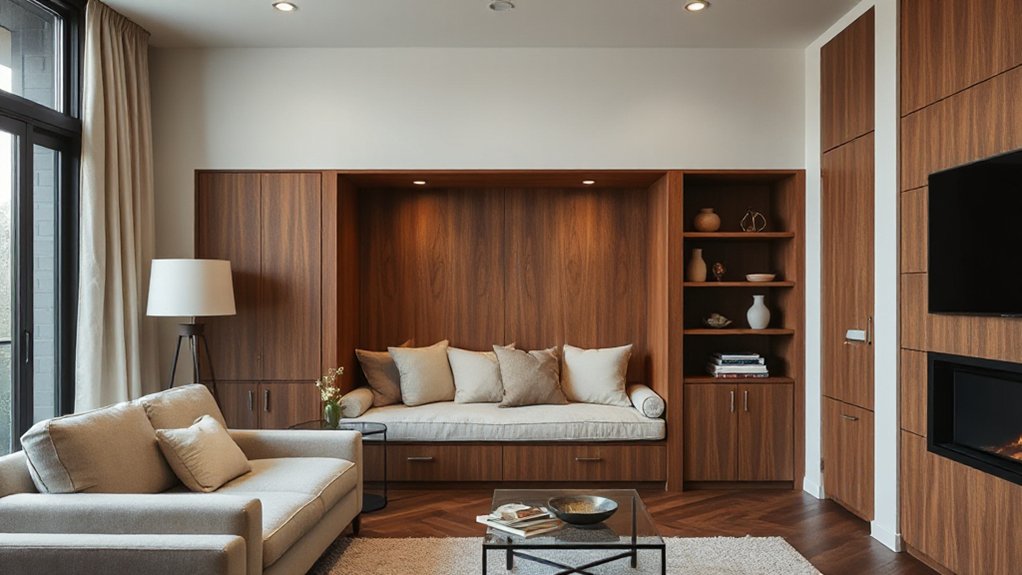
Built-in seating and storage should enhance the room without diminishing floor area. You’ll design multi-functional benches with integrated storage to minimize footprint while maximizing usability. Opt for shallow under-seat drawers or lift-top lids that reveal hidden compartments, preserving clean sightlines and avoiding bulk.
Precision in dimensions matters: seat height should align with adjacent furniture, and hinge mechanics must stay flush to prevent snagging fabrics. Use modular panels to accommodate varying ceiling heights and wall contours, ensuring seamless integration with inglenook alcoves.
Choose materials with low grain visibility or matching finishes to reduce visual weight. For storage, employ labeled bins or pull-out organizers that enable rapid access without obstructing circulation.
Vintage charm and cultural significance arise from thoughtful detailing, not excessive ornamentation.
The Hearth Today: Efficient Fire and Heat Management
You’ll assess how modern fireplaces optimize heat flow through precise combustion and controlled heat exchange. You’ll see how contemporary tech moderates radiant, conductive, and convective paths to maximize efficiency without sacrificing comfort.
This discussion centers on efficient heat flow and the latest fireplace innovations that support reliable, safe operation.
Efficient Heat Flow
You optimize grate geometry, ember management, and radiant-heat exchange by aligning firebox heat output with room geometry, avoiding oversized volumes that waste energy.
A correctly pitched chimney and minimized thermal bridges reduce flue heat loss, while seals prevent drafts that steal warmth.
You assess ventilation effectiveness to balance combustion needs with occupant comfort, ensuring fresh-air intake doesn’t undermine heat retention.
Fire safety remains paramount: you incorporate clear access for cleaning, proper clearances, and noncombustible surrounds.
Together, these measures yield predictable, efficient heat transfer, stable temperatures, and improved overall energy performance without compromising comfort or safety.
Modern Fireplace Tech
What makes today’s fireplace tech stand out is its integrated approach to control, efficiency, and safety, delivering consistent heat while reducing waste. You’ll find modulating burners, sealed combustion, and smart thermostats that sync with home systems, ensuring precise output and reduced emissions.
Advanced heat exchangers maximize transfer, while secondary air or catalytic stages optimize burn efficiency without compromising reliability. Clean startup sequences and fault monitoring provide real-time diagnostics, lowering maintenance and risk.
Cultural symbolism and historical significance converge as aesthetic and functional shaders—glass fronts, ember beds, and sculpted surrounds—without sacrificing performance. You gain rapid response to temperature shifts, zone control, and remote access, enabling adherence to building codes and energy goals.
Modern fireplace tech therefore blends heritage cues with rigorous engineering for dependable comfort.
Materials and Finishes for Warmth Without Clutter
Materials and finishes should contribute warmth without adding visual clutter, so select textures and tones that read as cohesive rather than busy. You’ll balance material contrasts to carve depth without distraction, pairing matte finishes with subtle sheen where needed.
Keep color accents intentional, choosing a restrained palette that reinforces the inglenook’s form without competing elements. Prioritize natural materials—wood, stone, brick—in controlled scales to maintain legibility and rhythm.
Texture variation should be tactile, not noisy, with grain alignment and grout lines minimized for clean sightlines.
- Material contrasts that read as cohesive rather than conflicting
- Color accents used sparingly to reinforce form
- Textural variety achieved through controlled finishes and grain direction
Layered Lighting to Shape Mood in the Inglenook
Layered light dynamics control how the inglenook reads at different times of day, balancing task, ambient, and accent layers for precise mood outcomes.
You’ll align light temperature, intensity, and direction to reinforce the space’s focal point while preserving plinths of shadow for depth.
This mood-driven illumination framework guides placement and fixtures so every moment in the nook feels intentional and measurable.
Layered Light Dynamics
Layered lighting in an inglenook uses a deliberate hierarchy of illumination to sculpt space, texture, and mood. You specify function-first layers: ambient, task, and accent, calibrated to the seating radius and hearth aperture.
Adjust color temperature and intensity to preserve natural architecture while directing attention to material contrasts. The arrangement supports natural ventilation by avoiding glare that compromises cross-vent flow, and it aids acoustic insulation by minimizing noisy reflections around the masonry.
- Establish a dimmable ambient wash that complements the hearth glow without overpowering it
- Implement task lighting at seating levels with focused, glare-free luminance
- Use discrete accent points to emphasize textures and architectural details
This approach yields precise control over perceived warmth, depth, and quiet, aligning with contemporary comfort and performance.
Mood-Driven Illumination
Tertiary accent lighting highlights architectural features—beams, alcoves, and the hearth—while housing integration maintains visual calm. You align color temperature and intensity to reinforce color harmony, ensuring warm tones near seating contrast with cooler task zones as needed.
Furniture placement informs fixture selection and zoning, guiding eye movement and micro-rhythms of interaction. Dimmer control, programming, and consistent beam angles preserve clarity during shifts between activities.
The result is a coherent mood framework that respects tradition while enabling contemporary adaptability.
Color Schemes That Tie Tradition to Contemporary
Color harmony emerges from balanced intensity, ensuring historic warmth coexists with current minimalism. Palette selection hinges on three pillars: tonal unity, material correspondence, and daylight responsiveness.
You’ll favor restrained hues—warm whites, soft taupes, and muted greens—paired with deeper, saturating accents to anchor the space. Avoid clashing undertones by testing swatches under natural light and varied times of day.
Implement subtle color shifts within fabrics, cabinetry, and trim to reinforce cohesion.
- Define a quiet field, then add measured accents
- Align textures and finishes with color intent
- Validate color harmony across access points and functions
Textures and Finishes That Age Gracefully

You’ll explore timeless texture pairings, pairing surfaces that gain appeal with age while remaining functional for daily use.
This section provides a concise overview of durable finishes and how they weather wear without compromising integrity.
Expect a precise discussion of patina development, its impact on character, and how to manage growth in a way that preserves value.
Timeless Texture Pairings
Texture pairings that age gracefully hinge on balancing tactile contrast with durable finishes. You’ll evaluate material pairings that resist wear while maintaining visual cohesion, focusing on how surface texture communicates tone and history. Prioritize restrained contrasts that read as intentional rather than accidental, aligning with Cultural symbolism and the momentum of Vintage revival.
Precision in material selection matters: choose hides or woven textiles with low-sheen, stone or brick with matte sealer, and timber veneers with UV protection. Maintain consistent grain alignment and edge detailing to preserve longevity and legibility of texture. Implement subtle pattern repetition to reduce noise and emphasize timelessness.
- Integrate tactile variety through matte stone, warm wood, and woven fabric accents
- Favor low-reflectance finishes to preserve nuance over time
- Align textures with cultural storytelling and historical references
Durable Finishes Overview
Durable finishes that age gracefully balance resistance with refinement, providing lasting legibility in a modern interior. You select coatings and surfaces that resist wear while preserving texture and tone, ensuring legibility across years of use.
In inglenook contexts, surface choices prioritize predictable behavior under heat, touch, and light, reducing the risk of rapid color shift or staining. You assess material longevity by evaluating hardness, oil/oil-absorption balance, UV stability, and cleanability, aligning with finish systems designed for high-traffic seating areas and shelving.
Prefinished or site-applied options should demonstrate uniform thickness and minimal microcracking. You document maintenance intervals, noting effortless renewal without altering base coloration.
Durable finishes minimize ongoing restoration work, enabling consistent perceived value. Material longevity emerges from balanced chemistry and disciplined application, not seasonal trend.
Patina and Character Growth
- patina evolution cues to assess ongoing durability and historical context
- controlled wear patterns that enhance tactile feedback and legibility
- finish systems designed for uniform aging and long-term stability
Furnishing the Modern Inglenook Without Crowding
To furnish a modern inglenook without crowding, prioritize compact, multi-functional pieces that fit within the alcove’s footprint while preserving open sightlines. You select seating and surfaces that maximize storage without extending beyond the alcove boundary.
Opt for low-profile, modular units with integrated drawers, hidden compartments, and slim profile arms to minimize visual mass. Choose a compact hearth surround, a restraint on ornamentation, and a single, restrained focal accessory to avoid clutter.
Confirm cord management is concealed and lighting is recessed to keep the plane clean. Emphasize Historical preservation and cultural significance by preserving original materials or finishes where feasible and documenting substitutions.
This approach sustains proportional balance, ergonomic comfort, and facilitating circulation, without sacrificing authentic, tradition-informed character.
Smart Layout: Flow From Public to Private Nooks
You’ll design the sequence from public gathering spaces to private nooks with clear sightlines and unobstructed circulation.
Prioritize spatial rhythm that guides movement intuitively, using passageways to signal shifts in use.
This flow supports functional separation while maintaining social cohesion and ease of access.
Public-to-Private Flow
- Define primary routes to private zones
- Calibrate lighting for mood and privacy
- Integrate materials signaling shift
Spatial Rhythm Navigation
Spatial rhythm navigates the built environment by shaping how you move from public spaces to private nooks, aligning circulation with perceptual cadence and functional zoning. You design pathways that synchronize sightlines, acoustic cues, and furniture scale to establish predictable, legible progressions.
Spatial rhythm navigation uses thresholds, material changes, and subtle lighting to signal shifts between social gathering zones and intimate retreat areas, reducing cognitive load while preserving flexibility.
You integrate cultural symbolism through material choices and motif placement, reinforcing meaning as users traverse spaces. Consider the historical evolution of room sequencing, ensuring that inglenook adjacencies support conversation, warmth, and privacy without abrupt discontinuities.
The result is a deliberate, measurable flow that enhances comfort, usability, and the perception of intentional, modern tradition.
Acoustic Comfort in Small, Cozy Spaces
- Implement sound insulation strategies for critical boundaries
- Apply acoustic treatment to balance absorption and diffusion
- Verify assembly integrity and sealant performance
Sustainable Practices for the Inglenook
Use eco-friendly materials selected for low embodied energy, moisture resistance, and scalable availability, avoiding volatile compounds that could compromise indoor air quality.
Prioritize renewable energy integration, such as solar-assisted heating or heat-recovery ventilation, to reduce operational demand without sacrificing comfort.
Specify durable finishes and reparable components, enabling predictable lifecycle performance and straightforward maintenance.
Document material provenance, installation methods, and performance targets to enable verifiable compliance with sustainability standards.
Monitor usage patterns and adjust controls to sustain efficiency, while retaining the inglenook’s core thermal comfort and aesthetic function.
Smart Tech That Supports, Not Dominate
Smart tech should support, not dominate, the inglenook by enhancing comfort and efficiency through targeted, unobtrusive systems. You implement AI integration to anticipate seating patterns, adjust lighting, and modulate ambient heat without distracting from the hearth’s focal presence.
Energy management is centralized, logging consumption and prioritizing low-impact modes during peak hours. You configure devices to respond to occupancy, weather, and user preferences, ensuring seamless operation with minimal manual input.
The result is a calm, functional space where technology disappears, leaving traditional warmth intact.
- AI integration enhances comfort without intrusion
- Energy management optimizes usage and reduces waste
- Subtle automation maintains ambiance while preserving craftsmanship
Case Study: Inglenook Transformed in a Loft
In a loft setting, the inglenook is reimagined to harness vertical space, open sightlines, and afternoon light without sacrificing its intimate core. You observe a disciplined integration of exposed masonry, engineered timber, and slim steel framing that preserves original silhouettes while enabling modern occupancy.
The transformation prioritizes structural efficiency: load paths, thermal breaks, and airflow channels are calibrated to sustain comfort without bulk. You note that seating, ancillary cabinetry, and a compact hearth are positioned to maintain circulation around the core nook, ensuring functional zoning.
Historical preservation informs detailing, from mortar joints to glazing profiles, while Cultural significance guides material choices and scale. The result is a legible adaptation that respects heritage and enhances contemporary loft usability without compromising authenticity.
Case Study: Inglenook as a Quiet Reading Nook
You observe the inglenook reconfigured as a compact, distraction-free reading retreat, where the seating is low and intimate, the hearth remains a focal point, and surrounding cabinetry minimizes visual clutter. This configuration foregrounds practical ergonomics and acoustic containment, enabling sustained, undisturbed reading sessions.
Cultural symbolism informs material choices, while historical significance anchors the niche within architectural tradition. You maximize light control with sidelights and a tight-seated chair, ensuring posture support and leg clearance.
The space functions as a quiet data point in daily life, marrying warmth with focus.
- Low-profile seating and supportive seating geometry optimize comfort during long reads
- Hearth-centered focal point preserves ambiance while reducing glare
- Cabinetry reduces visual noise, improving concentration and accessibility
Common Pitfalls in Inglenook Design and How to Avoid Them
Even with strong intent, inglenooks can fail if spatial proportions and traffic flow aren’t planned from the outset. You must assess scale, sightlines, and circulation to prevent awkward clearance and visual imbalance.
Pitfalls frequently involve tight seating, uneven lighting, or incompatible materials that clash with adjacent rooms. Avoid oversizing the hearth, which can dominate space and hamper use, and guarantee ventilation supports sustained heat without drafts.
Plan proportional furniture zones, ensuring access for furniture delivery and daily use. Cultural symbolism should be respected, aligning the nook with room function rather than novelty.
Address historical evolution by documenting era-appropriate details without overfurnishing. Maintain clear focal points, durable finishes, and consistent exposure to natural light.
Finally, integrate voids for acoustic comfort, reducing echo and preserving conversation clarity.
Budgeting Your Modern Inglenook Project
You’ll establish a fixed scope and quantify costs for each element, from framing and hearth to seating and finishes. Use conservative contingencies to absorb market fluctuations and design iterations. Track expenditures against budget in real time, and reallocate funds only when core performance criteria remain uncompromised. Prioritize transparent approvals and documented change orders to maintain cost control.
- Budget planning: define line items, unit costs, and tolerances; review weekly with stakeholders.
- Material sourcing: specify approved suppliers, lead times, and quantity thresholds to minimize waste.
- Risk management: embed contingency buffers and escalation paths to preserve schedule and quality.
Next Steps: Bringing Your Inglenook to Life
Bringing your inglenook to life starts with a disciplined execution plan that translates design intent into build-ready steps. You’ll define a measurable scope, sequence trades, and establish critical milestones aligned with code compliance.
Begin with structural verification: assess load paths, fire safety provisions, and clearances for seating, hearth, and ventilation. Develop detailed drawings, bill of materials, and installation tolerances to minimize on-site guesswork.
Integrate Historical context documentation to guarantee authenticity of materials, proportions, and finish. Address Cultural symbolism by prioritizing human-scale comfort, sightlines, and acoustics that reinforce gathering rituals.
Establish a quality-control checklist, perform pre-installation mockups, and coordinate supplier lead times. Conclude with commissioning criteria, safety handover, and a maintenance plan to sustain performance and timeless resonance.
Frequently Asked Questions
How Can an Inglenook Honor Heritage Without Cluttering Modern Interiors?
A well-placed inglenook preserves heritage by showcasing Cultural significance through restrained materials and precise detailing, while Design integration avoids clutter with clean lines, modular cabinetry, and strategic seating that emphasize function, balance, and contextual authenticity.
What Is the Ideal Minimum Depth for Built-In Seating?
Depth should be 18 inches for built-in seating. You’ll achieve seating comfort and space efficiency, minimizing intrusion while aligning with standard dims. Think tightrope precision—you balance comfort, support, and flow, crisp, measured, and technically anchored throughout.
How Can Lighting Balance Warmth and Modern Minimalism?
You balance lighting by layering ambient glow with task and accent fixtures, ensuring glare-free illumination and consistent color temperature, so you maintain cozy ambiance while preserving minimalist lines; use dimmers and warm LEDs to adapt to activities.
Is an Electric or Real Fire Safer in Compact Spaces?
An electric fire is generally safer in compact spaces, reducing burn risks and airflow hazards; you’ll minimize open flames. Prioritize fire safety, guarantee proper clearance and vents, and choose energy efficiency-rated models to maximize efficiency and safety.
Can an Inglenook Function as a Pantry or Storage Hub?
Yes, an inglenook can function as a pantry or storage hub. You should prioritize historical accuracy and material compatibility, ensuring cabinetry fits snugly, loads are balanced, and ventilation remains adequate, while maintaining precise, purposeful placement and predictable performance.
Conclusion
You can now implement an inglenook without sacrificing flow or storage. Prioritize placement that enhances privacy, optimize built-in seating, and select efficient, controllable heat sources. Maintain clear sightlines and integrate ventilation to avoid overheating. Use modular components to adapt as needs shift, and map lighting to focal seating zones. Plan for robust durability and easy maintenance, so this nook becomes a practical anchor—just don’t let it become a dead end, or you’ll miss the forest for the trees. You’ll have nailed it.