


To maximize seating and comfort in inglenook spaces, you should start with precise corner dimensions and map wall angles, entry clearances, seating depth, and aisle width to guarantee accessible sightlines and smooth traffic flow. Choose modular, ergonomic furniture that defines a clear seating perimeter without obstructing paths, and layer warm lighting with high-CRI fixtures. Opt for durable, stain‑resistant fabrics, low‑contrast upholstery, and protective finishes. Ready to optimize further details as you implement these principles.
Why Inglenook Corners Create Better Seating

Inglenook corners enhance seating by creating a natural, intimate gathering area within a room. You assess how enclosure channels conversation, distributes sightlines, and concentrates warmth, yielding a more inclusive seating dynamic than open layouts.
The inglenook history reveals a deliberate alignment of massing, fireplace proximity, and seating angles, which together reduce conversational fatigue and acoustic spill.
From an architectural styles perspective, the configuration complements traditional and contemporary motifs by providing a focal point that anchors furniture orientation and traffic flow. You leverage this ergonomic stability to optimize sightlines, legroom, and thermal comfort without excessive space.
In practice, deliberate placement supports sociability, minimizes movement, and sustains focus during interaction, delivering improved perceived comfort and functional efficiency through a compact, purpose-driven footprint.
Measure First: Corner Dimensions That Work
Before you lay out seating, establish precise corner dimensions that support both function and comfort. You determine the footprint by mapping wall angles, arc radii, and clearance for entry, seating depth, and aisle width.
Prioritize a consistent corner aesthetic, aligning seat backs, arms, and cushions to a uniform plane that favors sightlines and accessibility. Use accurate measurement practices: verify perpendicularity, account for baseboard intrusion, and document ceiling height influences on upholstery drop lines.
Mark measured points with durable markers, then translate them into a CAD or scaled sketch to check clearances. Confirm measurement accuracy under load conditions, considering cushions and occupants.
This disciplined approach prevents misfit furniture and awkward transitions, aligning the space with ergonomic needs while preserving a refined, cohesive Corner aesthetic.
Inglenook-Ready Furniture: Pieces for Comfort and Flow
Careful furniture selection enables seamless circulation and sustained comfort in an inglenook. You identify pieces that define the seating perimeter without interrupting access paths, prioritizing scale, proportion, and ergonomics.
Inglenook furniture should provide supportive seating with sufficient depth and back support to encourage lingering yet unobtrusive occupancy. Select modular options that adapt to varying guest loads, ensuring comfort flow around the hearth while leaving clear aisles to adjacent rooms.
Opt for low-contrast upholstery to minimize visual crowding and durable finishes that withstand daily use. Prioritize multiuse tables and compact ottomans that serve as surfaces and footrests without obstructing movement.
Clear sightlines and anchored corners enhance coordination between seating groups, preserving function while sustaining a calm, formal ambiance.
Cozy Texture, Color, and Lighting in Inglenook Nooks
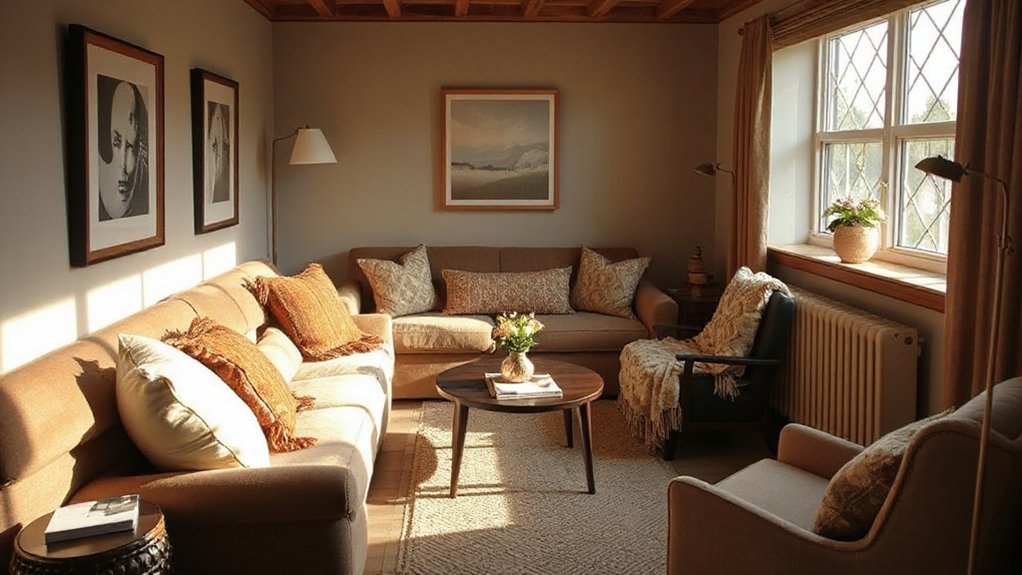
In your inglenook, cozy texture enhances tactile warmth, with natural fibers and subtle weaves that invite touch.
You layer warm lighting to create depth, using multiple fixtures to modulate color and mood without glare.
Consider how texture, color, and lighting interact to reinforce comfort and visual cohesion in intimate seating zones.
Cozy Texture Plays
Emphasize surface tactility to cue comfort without clutter, ensuring each element serves a functional and aesthetic purpose. Cozy textiles contribute resonance, absorbing ambient sound and framing seating geometry.
Maintain controlled repetition of color and texture to preserve the legibility of the focal seating area while reinforcing depth at the margins. Avoid visual noise by selecting fabrics with compatible undercurrents—warmth, durability, and subtle sheen—so the overall composition remains disciplined, inviting, and technically sound for sustained use.
Warm Lighting Layers
Begin with diffuse ceiling and wall fixtures to establish even base illumination, then introduce layered illumination for depth and warmth. Select warm white sources (2700–3000K) to preserve fabric hue and texture without glare.
Use dimmable fixtures to adapt to activity, mood, and time of day, preserving visual comfort while preventing harsh shadows in seating pockets. Blend lamps, sconces, and concealed LEDs to reinforce spatial rhythm, highlight upholstery, and define focal points.
Finally, calibrate color rendering indices above 90 to maintain texture fidelity.
Layout Tweaks for Traffic, Privacy, and Conversation

Effective traffic flow and user privacy in an inglenook space hinge on deliberate layout tweaks that facilitate smooth movement, minimize cross-traffic, and create clearly defined zones for conversation. You’ll implement calibrated sightlines and logical circulation paths that avoid congestion near doorway thresholds and seating clusters.
Position traffic corridors to align with primary entry points while preserving intimate conversation areas through spatial buffers and soft boundary cues. Incorporate privacy enhancement by elevating seating heights, staggering planters, or using modular screens to reduce line-of-sight exposure without detaching social cohesion.
Favor angular seating configurations that direct attention toward focal points, not footpaths. Guarantee clear, unambiguous wayfinding with consistent geometry and uniform finish treatment to sustain a calm, purposeful environment conducive to focused dialogue.
Durable Fabrics and Care for Busy Inglenook Corners
You select durable fabrics to withstand daily use, prioritizing stain-resistant fibers and tight weaves that resist abrasion.
We outline careful stain management and routine maintenance, so you can preserve color, texture, and structure with minimal disruption.
We provide practical, easy-clean maintenance tips that align with busy inglenook activity, ensuring long-term performance and clarity of choice.
Durable Fabrics Selection
Is it possible to select fabrics that balance aesthetics with long-term performance in a busy inglenook corner? You evaluate options through a practical lens, prioritizing performance alongside appearance.
Begin with ambient conditions: expect traffic patterns, UV exposure, and incidental moisture, then map these to material categories.
Indoor textiles should demonstrate consistent colorfastness, minimal pilling, and stable texture under repeated use.
Focus on Fabric durability as a core criterion, distinguishing weave integrity, fiber composition, and backing support that resist abrasion.
Prefer tight weaves and high-tenacity fibers for seating surfaces, with resilient finishes to ease maintenance.
Consider stain resistance as a supplementary attribute, while avoiding overreliance on surface treatments that may wear.
Conclude with a concise specification sheet to guide procurement, installation, and lifecycle planning for the inglenook corner.
Careful Stain Management
Stain removal becomes a defined process, not an afterthought, with clear roles for cleanup, containment, and evaluation. Begin with prompt blotting to prevent wicking, then use manufacturer-recommended cleaners appropriate to fiber type. Avoid harsh solvents that could degrade performance over time.
Fabric protection should include periodic reapplication of protective barriers where approved, and sealing high-risk seams or cushions when feasible. Document spill scenarios and responses to refine protocols.
Maintain systemic cleaning schedules that minimize soil buildup, preserving appearance, comfort, and the operational lifespan of your inglenook seating.
Easy-Clean Maintenance Tips
Durable fabrics make upkeep straightforward in busy inglenook corners, and this section presents practical, action-oriented tips for easy cleaning. You select stain resistant fabrics during procurement, prioritizing weaves that resist pilling and soil penetration.
For daily use, implement a routine: blot spills immediately with a clean, dry cloth; avoid rubbing to prevent embedded stain particles. When cleaning, rely on mild, pH-balanced solutions and test on an inconspicuous area first.
Use a soft-bristled brush to lift debris without abrading fibers, followed by a thorough rinse with distilled water to prevent residue. For high-traffic zones, opt for easy clean upholstery finishes and apply manufacturer-recommended protectants quarterly.
Schedule professional maintenance annually to sustain colorfastness, fiber integrity, and overall durability.
Frequently Asked Questions
How Can Inglenook Corners Adapt to Small Spaces Without Clutter?
Compact furniture and multifunctional storage let you adapt inglenooks to small spaces without clutter; you maintain clean lines, optimize function, and preserve flow, while you engage ergonomic seating, hidden compartments, and versatile surfaces for efficient use.
What Seating Height Best Suits Varied Lounging Preferences?
You should prioritize seating ergonomics by selecting modular pieces at varied heights to accommodate diverse lounge postures; aim for a range that supports both upright and reclined positions, optimizing comfort, stability, and neutral spine alignment across spaces.
Are There Eco-Friendly Materials Ideal for Busy Corners?
Yes, you’ll find eco-friendly options effective: recycled fabrics and bamboo panels. In a 35% reduction scenario, these materials perform comparably to conventional options, enabling durable, low-emission busy corners while maintaining professional aesthetics and functional resilience throughout use.
How Can Lighting Balance Both Ambiance and Readability Simultaneously?
Yes, balance ambient lighting and task illumination by layering fixtures; guarantee ambient provides overall glow while task lighting delivers focused clarity, enabling reading and conversation without glare or shadows for you. Maintain adjustable, even, color-consistent sources throughout.
What Maintenance Routine Keeps Upholstery Looking Fresh Long-Term?
You implement a cleaning schedule that schedules quarterly professional deep-cleaning and routine vacuuming; you guarantee stain prevention through barrier sprays and prompt blotting, maintaining fabric integrity, colorfastness, and longevity of upholstery in high-traffic inglenook seating.
Conclusion
In an inglenook, you balance space and solace, yet you don’t sacrifice flow. You lean into compact comfort, but you don’t concede openness; a snug corner can still invite conversation. Where rigid measurements threaten warmth, thoughtful proportions preserve sightlines and sociability. You pair durable fabrics with refined lighting, so activity endures without fatigue. Juxtapose busy traffic with quiet retreat, and you’ll find that coziness expands—precisely because restraint makes belonging feel deliberate, calm, and enduring.